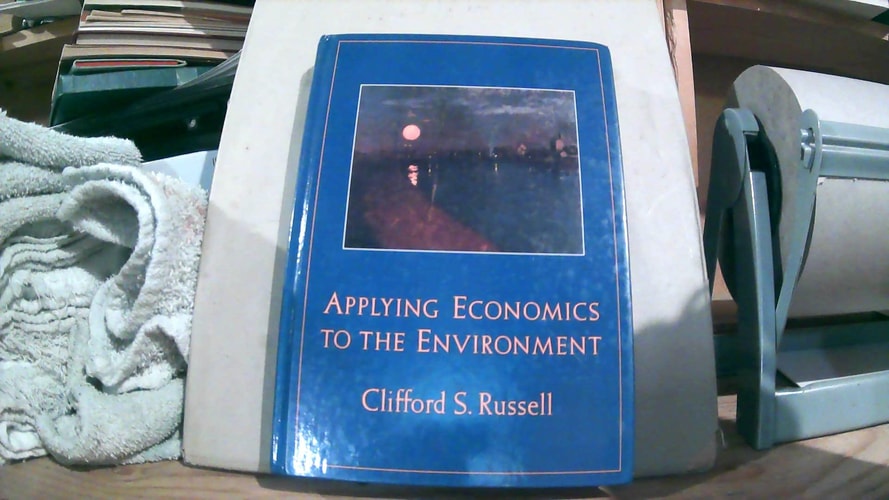
Applying Economics to the Environment
0
0
As an Amazon Associate and affiliate partner, Menrva Books earns from qualifying purchases. Learn more
Author Description
Applying Economics to the Environment is distinguished from other books on environmental economics by its breadth of coverage and its in-depth discussions of several key topics. The book's broad scope includes a chapter on how models of the natural world interact with economic models in ways that are central to the conclusions economists reach. It devotes a chapter to contingent valuation, currently the hottest topic in the field. It also contains a chapter on monitoring and enforcement, a topic often completely ignored but central to considerations of instrument choice. In addition, the final four chapters deal with the special problems of developing countries and the environment, both their own and our shared global systems. In terms of depth, the book's discussion of contingent valuation and related "direct" damage or benefit estimation techniques is unmatched outside the specialist literature. Its coverage of the choices available among policy instruments goes far beyond the usual simple discussions contrasting what is misleadingly known as "command control" with so-called economic or market-based instruments. This coverage reveals the complexity of the choice and the range of alternatives available. It also presents several of the newer ideas, in particular the use of publicly available information as a tool of environmental policy. Applying Economics to the Environment is intended to serve a dual market of upper-level college course programs in environmental economics as well as engineering and public policy courses that focus on the environment. The book can also provide an enlightening perspective for practicing professionals. Because the text includes a relatively sophisticated presentation of economic analysis, the author includes a full-chapter review of relevant microeconomic concepts. Some other features that further distinguish this book from currently available titles on the subject are: an introduction to the history of environmental policy and legis
Menrva's Summary
THE THESIS
How can economic principles be effectively applied to address complex environmental challenges and policy decisions? Clifford S. Russell, an expert in environmental economics, provides a comprehensive framework that bridges the gap between theoretical economic models and practical environmental management. By integrating microeconomic analysis with real-world policy constraints, the author argues for a more nuanced understanding of instrument choice, enforcement, and the specific environmental needs of developing nations.
THE SCOPE MAP
What You Will Find
- Integration of natural science models with economic frameworks
- In-depth analysis of contingent valuation and benefit estimation techniques
- Examination of monitoring and enforcement mechanisms in environmental policy
- Comparative study of policy instruments beyond simple market-based versus command-control models
- Dedicated analysis of environmental issues specific to developing countries
THE AUTHORITY PERSPECTIVE
Experts recognize this text as a rigorous resource for upper-level academic programs in economics, engineering, and public policy. Readers frequently note the sophisticated level of economic analysis, which is supported by a foundational review of microeconomic concepts for professional and student use.
Page Count:
400
Publication Date:
2001-03-08
Publisher:
Oxford University Press
ISBN-10:
019512684X
ISBN-13:
9780195126846
Economics
Public Policy
Community Tags
Similar Books