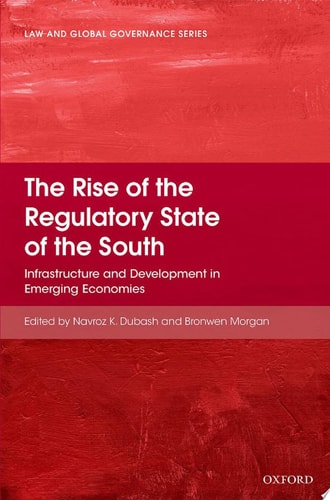
The Rise of the Regulatory State of the South: Infrastructure and Development in Emerging Economies
0
0
As an Amazon Associate and affiliate partner, Menrva Books earns from qualifying purchases. Learn more
Author Description
The 1990s and 2000s have witnessed a spurt of energetic institution-building in the developing world, as regulatory agencies emerge to take over the role of the executive in key sectors. This rise of the regulatory state of the south is barely noticed both by scholars of regulation and of development, let alone adequately documented and theorized. Yet the consequences for the role of the state and modalities of governance in the south are substantial, as politically charged decisions are handed over to formally technocratic agencies, creating new arenas and forms of contestation over the gains and losses from development decisions. Moreover, this shift in the developing world comes at a time when the regulatory state in the north is under considerable stress from the global financial crisis. Understanding the regulatory state of the south, and particularly forms of accommodation to political pressures, could stimulate a broader conversation around the role of the regulatory state in both north and south. This volume seeks to provoke such a discussion by empirically exploring the emergence of regulatory agencies of a range of developing countries across Asia, Africa, and Latin America. The cases focus on telecommunications, electricity, and water: sectors that have often been at the frontlines of this transition. The central question for the volume is: Are there distinctive features of the regulatory state of the South, shaped by the political-economic context of the global south in the last two decades? To assist in exploring this question, the volume includes brief commentaries on the case studies from a range of disciplines: development economics, law and regulation, development sociology, and comparative politics. Collectively, the volume seeks to shape the contours of a productive inter-disciplinary conversation on the emergence of a significant empirical phenomenon - the rise of regulatory agencies in the developing world - with implications both for the study
Menrva's Summary
THE THESIS
This volume investigates whether the emergence of regulatory agencies in the Global South exhibits distinctive characteristics shaped by specific political-economic contexts. Authors Bronwen Morgan and Navroz K. Dubash, both established scholars in law and environmental policy, synthesize empirical research to examine how developing nations transition executive functions to technocratic bodies. The text argues that this shift creates new arenas for political contestation and necessitates a re-evaluation of governance models in both the Global North and South.
THE SCOPE MAP
What You Will Find
- Comparative analysis of regulatory agencies in Asia, Africa, and Latin America.
- Sector-specific case studies focusing on telecommunications, electricity, and water infrastructure.
- Interdisciplinary commentaries from experts in development economics, sociology, and comparative politics.
Scope Limits
- The analysis does not provide a comprehensive global survey of every developing nation.
- The text does not offer prescriptive policy solutions but focuses on empirical documentation and theoretical framing.
THE AUTHORITY PERSPECTIVE
Scholars and policy analysts identify this work as a significant contribution to the under-researched field of regulatory development in emerging economies. Readers frequently note the academic density of the prose, which serves as a foundational text for those studying the intersection of law, governance, and international development.
Page Count:
320
Publication Date:
2013-01-01
Publisher:
OUP Oxford
ISBN-10:
0191668494
ISBN-13:
9780191668494
Economics
Public Policy
Law
Professional Career & Trade
Public Administration
Community Tags
Similar Books











Reader Comments
Share Your Thoughts
No comments yet. Be the first to share your thoughts!