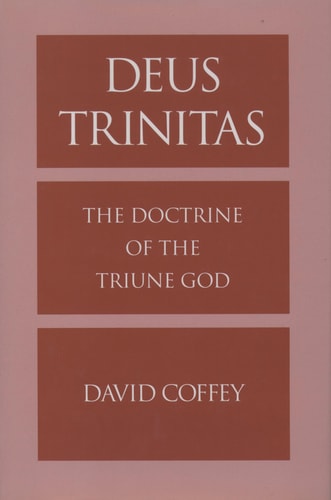
Deus Trinitas: The Doctrine of the Triune God
0
0
As an Amazon Associate and affiliate partner, Menrva Books earns from qualifying purchases. Learn more
Author Description
Recent years have seen a resurgence of interest in the doctrine of the Trinity, following a long period in which it was considered irrelevant to the rest of theology and to the challenge of Christian life. In this book, David Coffey claims that this resurgence is caused by a renewed appreciation of the fact that salvation itself has a Trinitarian structure. He argues that we cannot understand salvation without a solid understanding of the Trinity.Coffey considers the full range of issues surrounding this central doctrine of Christian faith. Viewing the doctrine of the Trinity in its historical and ecumenical context, he seeks to arrive at a balanced vision that incorporates the insights of both the Western and the Eastern Churches. In particular, he wants to keep in sight both the immanent Trinity (the Godhead considered in itself) and the economic Trinity (that is, its role within the economy of salvation). In Coffeys own model of the Trinity, the Holy Spirit is seen as the objectivization of the mutual love of the Father and the Son. This idea is most closely associated with St. Augustine and Richard of St. Victor. Coffey, however, takes it much further, presenting it as an explanation of the origin of the Son and the Holy Spirit and of the manner of operation of the Trinity in the economy. From this model, he is also able to derive a suggestion for resolving the ecumenical problem of Filioquism vs. Monopatrism (concerning the procession of the Holy Spirit)-- the issue that has divided East from West for nearly a millennium.Presenting a new perspective on a topic of renewed theological interest, this comprehensive study has important implications for ecumenical discussions of the Trinity.
Menrva's Summary
THE THESIS
This book investigates the central doctrine of the Trinity by arguing that a proper understanding of salvation is inextricably linked to a Trinitarian framework. David Coffey, a theologian specializing in systematic theology, utilizes historical and ecumenical perspectives to bridge the divide between Western and Eastern theological traditions. He proposes a specific model of the Trinity, rooted in the Augustinian tradition, to explain the internal operations of the Godhead and the external economy of salvation. By re-examining these classical concepts, the author seeks to provide a resolution to long-standing ecumenical disputes regarding the procession of the Holy Spirit.
THE SCOPE MAP
What You Will Find
- Historical analysis of the immanent and economic Trinity.
- A proposed theological model defining the Holy Spirit as the objectivization of mutual love between the Father and the Son.
- Comparative study of Western and Eastern Church doctrines.
- A framework for addressing the historical conflict between Filioquism and Monopatrism.
THE AUTHORITY PERSPECTIVE
Scholars and theologians recognize this work as a significant contribution to contemporary Trinitarian discourse, particularly for its attempt to reconcile divergent ecumenical traditions. Readers frequently note the academic density of the prose, which requires a foundational understanding of systematic theology to fully grasp the author's complex arguments.
Page Count:
208
Publication Date:
1999-09-09
Publisher:
Oxford University Press
ISBN-10:
0195124723
ISBN-13:
9780195124729
Philosophy
Religion
Christianity
Theology
Trinity
Community Tags
Similar Books