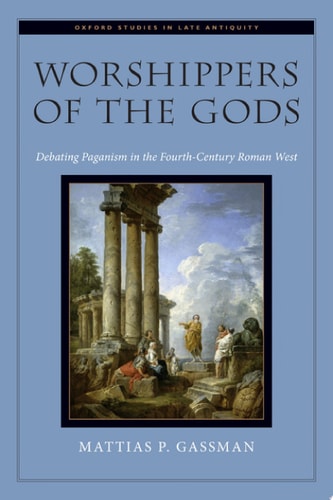
Worshippers of the Gods: Debating Paganism in the Fourth-Century Roman West
0
0
As an Amazon Associate and affiliate partner, Menrva Books earns from qualifying purchases. Learn more
Author Description
Worshippers of the Gods tells how the Latin writers who witnessed the political and social rise of Christianity rethought the role of traditional religion in the empire and city of Rome. In parallel with the empire's legal Christianisation, it traces changing attitudes toward paganism from the last empire-wide persecution of Christians under the Tetrarchy to the removal of state funds from the Roman cults in the early 380s. Influential recent scholarship has seen Christian polemical literature-a crucial body of evidence for late antique polytheism-as an exercise in Christian identity-making. In response, Worshippers of the Gods argues that Lactantius, Firmicus Maternus, Ambrosiaster, and Ambrose offered substantive critiques of traditional religion shaped to their political circumstances and to the preoccupations of contemporary polytheists. By bringing together this polemical literature with imperial laws, pagan inscriptions, and the letters and papers of the senator Symmachus, Worshippers of the Gods reveals the changing horizons of Roman thought on traditional religion in the fourth century. Through its five interlocking case studies, it shows how key episodes in the Empire's religious history-the Tetrarchic persecution, Constantine's adoption of Christianity, the altar of Victory affair, and the 'disestablishment' of the Roman cults-shaped contemporary conceptions of polytheism. It also argues that the idea of a unified 'paganism', often seen as a capricious invention, actually arose as a Christian response to the eclectic, philosophical polytheism in vogue at Rome.
Menrva's Summary
THE THESIS
This work investigates how Latin writers during the fourth-century Roman Empire reinterpreted traditional polytheistic religion amidst the rapid legal and social Christianization of the state. Mattias Philip Gassman utilizes a rigorous analysis of polemical literature, imperial legislation, and private correspondence to argue that Christian critiques of paganism were not merely identity-building exercises, but substantive responses to the political realities and philosophical trends of the era. By examining the works of figures such as Lactantius and Ambrose, the author demonstrates how these writers engaged with the specific religious preoccupations of their polytheist contemporaries.
THE SCOPE MAP
What You Will Find
- Analysis of the transition from the Tetrarchic persecution to the disestablishment of Roman cults in the 380s.
- Examination of the Altar of Victory affair and the influence of Constantine’s conversion.
- Synthesis of Christian polemical texts, imperial laws, pagan inscriptions, and the papers of the senator Symmachus.
Scope Limits
- The study focuses primarily on the Latin-speaking West, excluding a detailed comparative analysis of the Greek-speaking East.
- The research does not provide an exhaustive history of all Roman cultic practices, focusing instead on the intellectual debates surrounding them.
THE AUTHORITY PERSPECTIVE
Scholars in the field of Late Antiquity recognize this text as a significant contribution to the study of religious polemics and the construction of the category of paganism. Readers frequently note the academic density of the prose and the author's meticulous integration of diverse primary source materials.
Page Count:
248
Publication Date:
2020-01-01
Publisher:
Oxford University Press
ISBN-10:
0190082461
ISBN-13:
9780190082468
History
Religion
Roman Empire
Ancient History
Christianity
Paganism
Late Antiquity
Community Tags
Similar Books