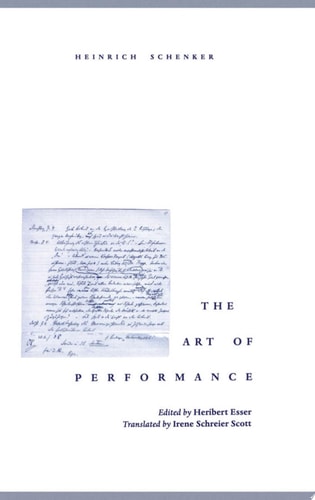
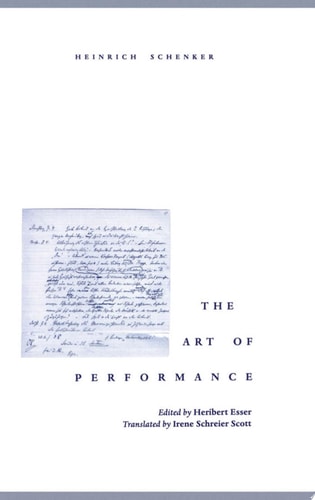
The Art of Performance
0
0
As an Amazon Associate and affiliate partner, Menrva Books earns from qualifying purchases. Learn more
Author Description
Heinrich Schenker's The Art of Performance shows this great music theorist in a new light. While his theoretical writings helped transform music theory in the twentieth century, this book draws on his experience as a musician and teacher to propose a sharp reevaluation of how musical compositions are realized in performance. Filled with concrete examples and numerous suggestions, the book will interest both music theorists and practicing performers.Schenker's approach is based on his argument that much of contemporary performance practice is rooted in the nineteenth-century cult of the virtuoso, which has resulted in an overemphasis on technical display. To counter this, he proposes specific ways to reconnect the composer's intentions and the musician's performance.Schenker begins by showing how performers can benefit from understanding the laws of composition. He demonstrates how a literal interpretation of the composer's indications can be self-defeating, and he provides a lively discussion of piano technique, including suggestions for pedal, sound color, orchestral effects, and balance. He devotes separate chapters to non-legato, legato, fingering, dynamics, tempo, and rests. In addition to the examples for pianists, Schenker covers a number of topics, such as bowing technique, that will prove invaluable for other instrumentalists and for conductors. The book concludes with an aphoristic and sometimes lyrical chapter on practicing.After Schenker's death, his student Oswald Jonas prepared the text for publication from Schenker's notes, eventually leaving the manuscript to his stepdaughter, Irene Schreier Scott, who entrusted the work of organizing and editing the disparate material to Jonas's friend and student Heribert Esser. She later translated it into English. This edition is the first publication in any language of this remarkable work.
Menrva's Summary
THE THESIS
Heinrich Schenker investigates how the laws of musical composition should inform and guide the practical realization of performance to counter the excessive technical display of the virtuoso era. Schenker, a prominent twentieth-century music theorist, draws upon his extensive background as a teacher and musician to argue that contemporary performance practice often obscures the composer's original intent. By applying his analytical framework to the physical act of playing, he provides a methodology for performers to align their interpretations with the structural integrity of the musical score.
THE SCOPE MAP
What You Will Find
- Detailed analysis of piano techniques including pedal usage, sound color, and orchestral effects.
- Technical chapters covering non-legato, legato, fingering, dynamics, tempo, and the function of rests.
- Practical guidance for instrumentalists and conductors on bowing and balance.
- A philosophical and pedagogical exploration of effective practice habits.
THE AUTHORITY PERSPECTIVE
Experts and musicologists view this work as a significant addition to the Schenkerian canon, offering a rare glimpse into the practical application of his theories. Readers frequently note the technical density of the prose, which serves as a foundational text for those seeking to bridge the gap between theoretical analysis and performance.
Page Count:
136
Publication Date:
2000-03-23
Publisher:
Oxford University Press
ISBN-10:
0195122542
ISBN-13:
9780195122541
Music
Piano Music
Performance
Performance Practice
Piano
Music theory
Community Tags
Other Editions(2)
Similar Books