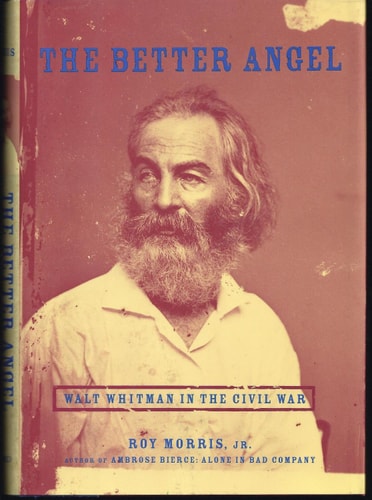
The Better Angel: Walt Whitman in the Civil War
0
0
As an Amazon Associate and affiliate partner, Menrva Books earns from qualifying purchases. Learn more
Author Description
On May 26, 1863, Walt Whitman wrote to his mother: "O the sad, sad things I see--the noble young men with legs and arms taken off--the deaths--the sick weakness, sicker than death, that some endure, after amputations...just flickering alive, and O so deathly weak and sick." For nearly three years, Whitman immersed himself in the devastation of the Civil War, tending to thousands of wounded soldiers and recording his experience with an immediacy and compassion unequaled in wartime literature anywhere in the world.In The Better Angel, acclaimed biographer Roy Morris, Jr. gives us the fullest accounting of Whitman's profoundly transformative Civil War Years and an historically invaluable examination of the Union's treatment of its sick and wounded. Whitman was mired in depression as the war began, subsisting on journalistic hackwork, wasting his nights in New York's seedy bohemian underground, his "great career" as a poet apparently stalled. But when news came that his brother George had been wounded at Fredericksburg, Whitman rushed south to find him. Though his brother's injury was slight, Whitman was deeply affected by his first view of the war's casualties. He began visiting the camp's wounded and, almost by accident, found his calling for the duration of the war. Three years later, he emerged as the war's "most unlikely hero," a living symbol of American democratic ideals of sharing and brotherhood.Instead of returning to Brooklyn as planned, Whitman continued to visit the wounded soldiers in the hospitals in and around the capital. He brought them ice cream, tobacco, brandy, books, magazines, pens and paper, wrote letters for those who were not able and offered to all the enormous healing influence of his sympathy and affection. Indeed, several soldiers claimed that Whitman had saved their lives. One noted that Whitman "seemed to have what everybody wanted" and added "When this old heathen came and gave me a pipe and tobacco, it was about the most joyful moment o
Menrva's Summary
THE THESIS
This work investigates how the American Civil War served as a catalyst for Walt Whitman's personal transformation and the development of his humanitarian identity. Roy Morris, Jr. utilizes primary source documents, including Whitman's personal correspondence and wartime journals, to reconstruct the poet's transition from a disillusioned journalist to a dedicated volunteer nurse in Washington, D.C. The book argues that Whitman's direct exposure to the suffering of soldiers fundamentally reshaped his poetic vision and solidified his role as a symbol of democratic brotherhood.
THE SCOPE MAP
What You Will Find
- A detailed account of Whitman's life in the New York bohemian underground prior to 1863.
- An examination of the medical conditions and logistical challenges within Union military hospitals.
- Primary source analysis of Whitman's letters to his family and his later published reflections on the war.
- A study of the psychological and social impact of the war on the American public consciousness.
THE AUTHORITY PERSPECTIVE
Historians and literary critics frequently cite this text as a definitive account of Whitman's formative wartime experiences. The narrative is noted for its balance between meticulous historical research and an accessible, empathetic prose style.
Page Count:
288
Publication Date:
2000-07-27
Publisher:
Oxford University Press
ISBN-10:
0195124820
ISBN-13:
9780195124828
History
Biography
Poetry
Civil War
Biography Autobiography
English
American History
English & College Success
American
Community Tags
Similar Books