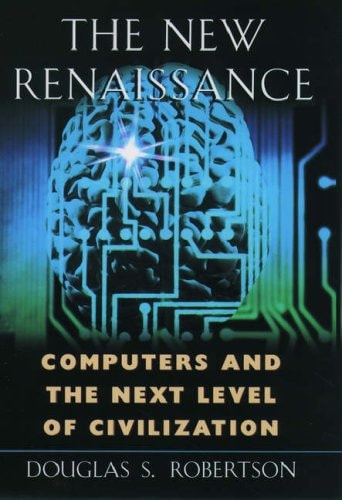
The New Renaissance: Computers and the Next Level of Civilization
0
0
As an Amazon Associate and affiliate partner, Menrva Books earns from qualifying purchases. Learn more
Author Description
The electronic computer, argues Douglas Robertson, is the most important invention in the history of technology, if not all history It has already set off an information explosion that has changed many facets of civilization beyond recognition. These changes have ushered in nothing less than the dawn of a new level of civilization.In The New Renaissance, Robertson offers an important historical perspective on the computer revolution, by comparing it to three earlier landmarks of human development--language, writing, and printing. We see how these three inventions changed how we capture, store, and distribute information, and how each thereby triggered an information explosion that transformed society, ushering in a new civilization utterly unlike anything before. But history has never seen a revolution on the scale of the one being sparked by computers today. What can we expect from the most important technological breakthrough in human history? Robertson lays out possible scenarios regarding transformations in science and mathematics, education, language, the arts, and everyday life. School children, for instance, will forsake pencil and paper for keyboard and calculator, much as their forebears forsook clay tablets and abaci for pencil and paper. In films, the computer simulations of Jurassic Park could be eclipsed by "synthespians," artificial actors indistinguishable from living ones.Whether one is a computer enthusiast, a popular science buff, or simply someone fascinated by the future, The New Renaissance provides a breathtaking peek at the magnitude of changes we can expect as the full power of computers is unleashed.
Menrva's Summary
THE THESIS
Does the advent of the electronic computer represent the most significant technological shift in human history, surpassing the impact of language, writing, and the printing press? Douglas S. Robertson, drawing on his background in technological history and systems analysis, argues that we are currently witnessing the dawn of a new level of civilization. He posits that just as previous information revolutions fundamentally restructured society, the computer revolution is currently catalyzing a transformation that will alter the core mechanics of human existence, from scientific inquiry to artistic expression.
THE SCOPE MAP
What You Will Find
- A comparative analysis of four major information revolutions: language, writing, printing, and computing.
- Projections regarding the evolution of education, mathematics, and the arts in a post-digital society.
- Theoretical frameworks for understanding how information storage and distribution dictate the structure of civilization.
- Speculative scenarios concerning the integration of artificial intelligence and synthetic media into everyday life.
THE AUTHORITY PERSPECTIVE
Experts and readers often categorize this work as a foundational text for understanding the early societal impacts of the digital age. While some critics note the speculative nature of the author's future projections, the book remains a frequently cited resource for those examining the historical trajectory of information technology.
Page Count:
208
Publication Date:
1998-09-17
Publisher:
Oxford University Press
ISBN-10:
0195121899
ISBN-13:
9780195121896
History
Science
Future Studies
Technology
Computers and civilization
Sociology
Community Tags
Similar Books