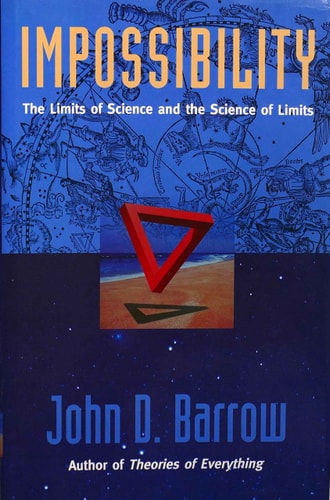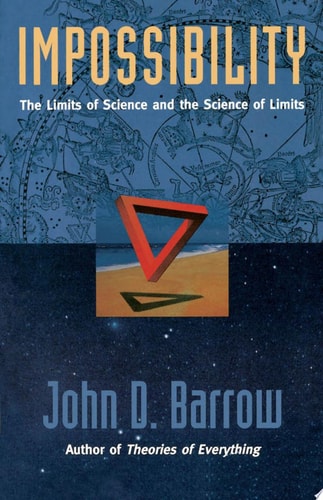
Impossibility: The Limits of Science and the Science of Limits
0
0
As an Amazon Associate and affiliate partner, Menrva Books earns from qualifying purchases. Learn more
Author Description
In Impossibility, John D. Barrow--one of our most elegant and accomplished science writers--argues convincingly that there are limits to human discovery, that there are things that are ultimately unknowable, undoable, or unreachable. Barrow first examines the limits of the human mind: our brain evolved to meet the demands of our immediate environment, and much that lies outside this small circle may also lie outside our understanding. He investigates practical impossibilities, such as those imposed by complexity, uncomputability, or the finiteness of time, space, and resources. Is the universe finite or infinite? Can information be transmitted faster than the speed of light? The book also examines deeper theoretical restrictions on our ability to know, including Godel's theorem, which proved that there were things that could not be proved. Finally, having explored the limits imposed on us from without, Barrow considers whether there are limits we should impose upon ourselves. Weaving together this intriguing tapestry, Barrow illuminates some of the most profound questions of science, from the possibility of time travel to the very structure of the universe.
Menrva's Summary
THE THESIS
This book investigates the fundamental question of whether there are inherent, insurmountable boundaries to human knowledge and scientific discovery. John D. Barrow, a renowned cosmologist and science writer, utilizes a multidisciplinary approach to argue that certain phenomena are permanently beyond the reach of human inquiry. By synthesizing insights from mathematics, physics, and evolutionary biology, he constructs a framework that categorizes these restrictions into cognitive, practical, and theoretical domains.
THE SCOPE MAP
What You Will Find
- Analysis of cognitive limitations imposed by human evolutionary history.
- Examination of practical constraints such as computational complexity and finite physical resources.
- Discussion of theoretical barriers including Godel's incompleteness theorems.
- Exploration of scientific paradoxes like time travel and the speed of light.
THE AUTHORITY PERSPECTIVE
Experts and readers alike recognize this work as a sophisticated exploration of the intersection between physics and philosophy. The text is noted for its accessible prose, though it maintains a high level of intellectual rigor suitable for those interested in the philosophical implications of modern science.
Page Count:
304
Publication Date:
1999-10-28
Publisher:
Oxford University Press
ISBN-10:
0195130820
ISBN-13:
9780195130829
Science
Physics
Cosmology
Mathematics
Science