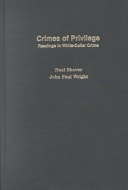
Crimes of Privilege: Readings in White-Collar Crime
0
0
As an Amazon Associate and affiliate partner, Menrva Books earns from qualifying purchases. Learn more
Author Description
Nearly six decades have passed since the concept of white-collar crime was introduced and systematic scholarly investigation of it began. Although it has proven to be one of the most challenging and controversial topics in sociology, the concept has taken firm root in lay and scholarly lexicons where it is widely understand and used to denote a type of crime that differs fundamentally from street crime. One way it is different is the backgrounds and characteristics of it perpetrators; the poor and disreputable fodder routinely encountered in police stations and in studies of street crime are seldom in evidence here. Most if not all white-collar offenders by contrast are distinguished by lives by privilege, much of it with origins in class inequality.This reader begins together under a unifying theoretical approach the current state of knowledge about and debate over white-collar crime. Editors' introductions preface each of the six chapters in the book, and each of the thirty-one carefully chosen selections --- both classic and contemporary -- has been significantly edited for readability and suitability for the college student. The readings address conceptual conflicts as well as empirical studies of the strucutre of opportunities, the characteristics of white-collar offenders and their decision making, and the various approaches to controlling white-collar offering. Additionally, the book includes twenty-one specially designed panels that call-out particular issues from the readings by offering case examples taken from local and regional newspapers. Together, the readings and the panels offer the student both analysis and examples of white-collar crime.
Menrva's Summary
THE THESIS
This volume investigates the conceptual foundations, empirical realities, and control mechanisms surrounding white-collar crime within the context of class inequality. Neal Shover and John P. Wright, both established scholars in the field of criminology, curate a collection of thirty-one seminal and contemporary readings. They utilize a unifying theoretical framework to distinguish white-collar offenses from traditional street crime, focusing on the unique backgrounds of perpetrators who possess significant social and economic privilege.
THE SCOPE MAP
What You Will Find
- Six thematic chapters covering conceptual conflicts and empirical studies of offender decision-making.
- Twenty-one specialized panels providing real-world case examples from local and regional media.
- Edited selections of classic and contemporary academic literature tailored for undergraduate comprehension.
- Analysis of the structural opportunities that facilitate white-collar criminal behavior.
THE AUTHORITY PERSPECTIVE
Experts and educators frequently cite this text as a foundational resource for undergraduate criminology courses due to its structured approach and accessible editing. Readers note that the inclusion of case study panels effectively bridges the gap between abstract sociological theory and practical application in the legal system.
Page Count:
448
Publication Date:
2000-10-12
Publisher:
Oxford University Press
ISBN-10:
0195136209
ISBN-13:
9780195136203
Non-Fiction
Sociology
Criminology
Law
White Collar Crimes
Community Tags
Similar Books