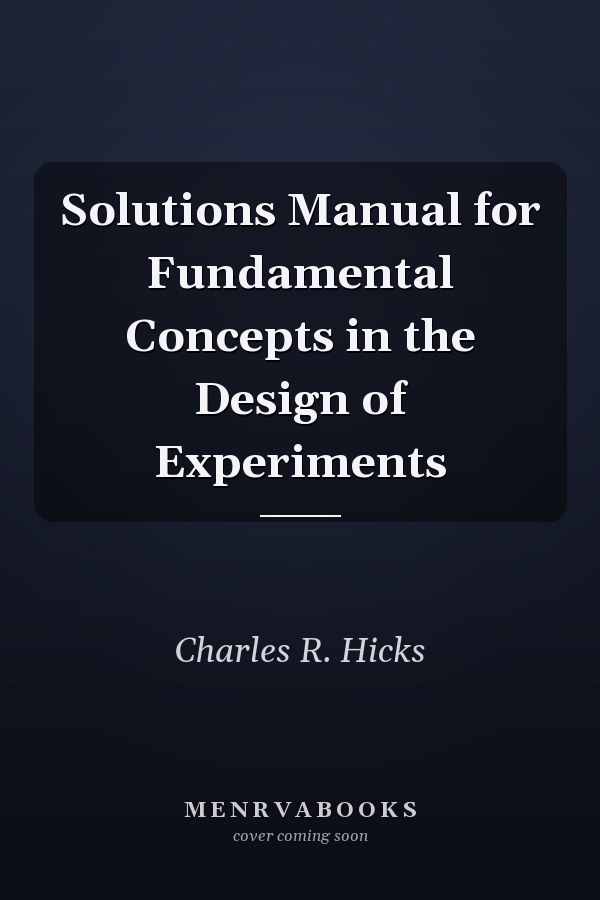
Solutions Manual for Fundamental Concepts in the Design of Experiments
0
0
As an Amazon Associate and affiliate partner, Menrva Books earns from qualifying purchases. Learn more
Author Description
Fundamental Concepts In The Design Of Experiments, 5e Offers Comprehensive Coverage Of The Key Elements Of Experimental Design Used By Applied Researchers To Solve Problems In The Field. Wide-ranging And Accessible, It Shows Students How To Use Applied Statistics For Planning, Running, And Analyzing Experiments. Featuring Over 350 Problems Taken From The Authors' Actual Industrial Consulting Experiences, The Text Gives Students Valuable Practice With Real Data And Problem Solving. The Problems Emphasize The Basic Philosophy Of Design And Are Simple Enough For Students With Limited Mathematical Backgrounds To Understand. The Authors Provide Extensive Coverage Of The Analysis Of Residuals, The Concept Of Resolution In Fractional Replications, Plackett-burman Designs, And Taguchi Techniques. Sas (statistical Analysis System) Computer Programs Are Incorporated To Facilitate Analysis.thoroughly Revised And Updated, This New Edition Includes Sixty New Problems, Focuses More On Computer Use (adding Computer Outputs From Statistical Packages Like Minitab, Spss, And Jmp), And Emphasizes Graphical Procedures Including Residual Plots And Normal Quantile Plots. Ideal For Various Advanced Undergraduate And Graduate Experimental Methods Courses Taught In Statistics, Engineering, And Mathematics Departments, This Book Will Also Appeal To Professionals And Researchers Doing Experimental Work.
Menrva's Summary
THE THESIS
This manual serves as the definitive companion to the fifth edition of Fundamental Concepts in the Design of Experiments, addressing the core challenge of applying statistical theory to practical industrial problem-solving. Authors Charles R. Hicks and Kenneth V. Turner Jr. leverage their extensive backgrounds in industrial consulting to provide detailed solutions and methodological guidance. The text bridges the gap between theoretical experimental design and real-world application, offering a structured framework for interpreting data and validating statistical models.
THE SCOPE MAP
What You Will Find
- Step-by-step solutions for over 350 industrial experimental design problems.
- Practical guidance on utilizing statistical software packages including SAS, Minitab, SPSS, and JMP.
- Methodological breakdowns of residual analysis, fractional replication, and Taguchi techniques.
- Graphical interpretation strategies, specifically focusing on residual plots and normal quantile plots.
THE AUTHORITY PERSPECTIVE
Experts and educators frequently cite this manual as a necessary resource for students and practitioners navigating the complexities of experimental design. Readers often note the clarity of the solutions, which effectively demystify the application of statistical software in professional research environments.
Page Count:
202
Publication Date:
1999-08-05
Publisher:
Oxford University Press, Incorporated
ISBN-10:
0195135202
ISBN-13:
9780195135206
Engineering
Probabilities
Reference
Mathematics
Statistics
Community Tags
Similar Books