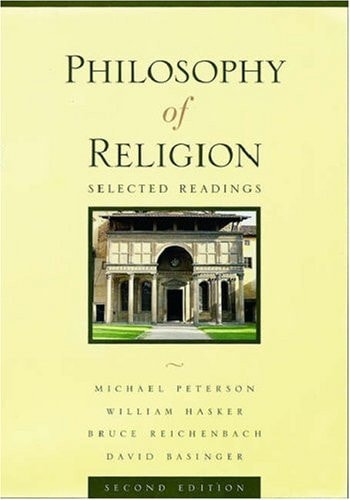
Philosophy of Religion: Selected Readings
0
0
As an Amazon Associate and affiliate partner, Menrva Books earns from qualifying purchases. Learn more
Author Description
The second edition of this excellent anthology in the philosophy of religion examines both the basic classical and a host of contemporary issues. Assuming little or no familiarity with the religious concepts it addresses, it provides a well-balanced and accessible approach to the field. The seventy-one articles cover standard subjects--including religious experience, theistic arguments, the problem of evil, and miracles--as well as topics that have recently gained the attention of philosophers of religion, such as reformed epistemology, the philosophical analysis of theological doctrine, and the kalam theological argument. The collection also discusses topics often requested by instructors but seldom covered in competing texts, including religion and science, religious pluralism, process theism, and religious ethics.An ideal teaching text, Philosophy of Religion, 2/e, is organized into thirteen thematic sections. Each section begins with a revised introduction and ends with updated suggestions for further reading. While it deals primarily with the Western tradition in the philosophy of religion, this second edition also adds readings representing continental, feminist, and Asian contributions to the field. New selections include essays by Sarah Coakley, the Dalai Lama, Richard Dawkins, Stephen Jay Gould, Lao Tsu, Moses Maimonides, and the Upanishads. Philosophy of Religion, 2/e, functions well as a stand-alone textbook for courses in the philosophy of religion and is readily compatible for use as a primary source reader in conjunction with a secondary text. It is an ideal companion to the editors' textbook, Reason and Religious Belief, 2/e (OUP, 1997), as the two books share the same topical organization.
Menrva's Summary
THE THESIS
This anthology investigates the central questions of religious belief and philosophical inquiry through a curated selection of classical and contemporary academic discourse. The editors, all established scholars in the field, provide a structured framework that balances foundational arguments with modern developments in epistemology and theology. By organizing seventy-one distinct articles into thirteen thematic sections, the text offers a comprehensive overview of the logical and metaphysical challenges inherent in religious thought. The volume serves as a pedagogical tool designed to introduce students to the rigorous analysis of faith, doctrine, and theistic arguments.
THE SCOPE MAP
What You Will Find
- Classical and contemporary arguments regarding the existence of God and the problem of evil.
- Analysis of religious experience, miracles, and the intersection of religion and science.
- Diverse perspectives including continental, feminist, and Asian philosophical contributions.
- Pedagogical apparatus including section introductions and updated bibliographies for further research.
THE AUTHORITY PERSPECTIVE
Instructors frequently utilize this text as a foundational reader due to its clear organization and broad thematic coverage. Experts highlight the inclusion of diverse global perspectives as a significant improvement over more traditional, Western-centric anthologies in the field.
Page Count:
640
Publication Date:
2000-12-14
Publisher:
Oxford University Press
ISBN-10:
0195135466
ISBN-13:
9780195135466
Religion
Philosophy
Theology
Christianity
textbook
Religion
Community Tags
Similar Books