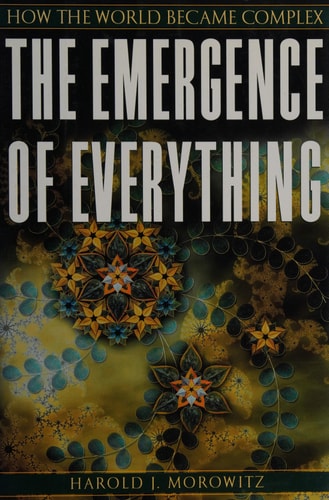
The Emergence of Everything: How the World Became Complex
0
0
As an Amazon Associate and affiliate partner, Menrva Books earns from qualifying purchases. Learn more
Author Description
When the whole is greater than the sum of the parts--indeed, so great that the sum far transcends the parts and represents something utterly new and different--we call that phenomenon emergence. When the chemicals diffusing in the primordial waters came together to form the first living cell, that was emergence. When the activities of the neurons in the brain result in mind, that too is emergence.In The Emergence of Everything, one of the leading scientists involved in the study of complexity, Harold J. Morowitz, takes us on a sweeping tour of the universe, a tour with 28 stops, each one highlighting a particularly important moment of emergence. For instance, Morowitz illuminates the emergence of the stars, the birth of the elements and of the periodic table, and the appearance of solar systems and planets. We look at the emergence of living cells, animals, vertebrates, reptiles, and mammals, leading to the great apes and the appearance of humanity. He also examines tool making, the evolution of language, the invention of agriculture and technology, and the birth of cities. And as he offers these insights into the evolutionary unfolding of our universe, our solar system, and life itself, Morowitz also seeks out the nature of God in the emergent universe, the God posited by Spinoza, Bruno, and Einstein, a God Morowitz argues we can know through a study of the laws of nature.Written by one of our wisest scientists, The Emergence of Everything offers a fascinating new way to look at the universe and the natural world, and it makes an important contribution to the dialogue between science and religion.
Menrva's Summary
THE THESIS
How does the phenomenon of emergence explain the transition from simple physical laws to the complex structures of life, mind, and human civilization? Harold J. Morowitz, a biophysicist and expert in complexity theory, utilizes a chronological framework to analyze the universe's development. By mapping 28 distinct stages of emergence, he argues that the universe possesses an inherent tendency toward increasing complexity, ultimately suggesting that the laws of nature themselves provide a pathway to understanding the divine.
THE SCOPE MAP
What You Will Find
- A 28-stage chronological timeline of cosmic and biological evolution.
- Analysis of transitions from primordial chemicals to the first living cells.
- Examination of the evolution of consciousness, tool-making, and urban development.
- A philosophical synthesis connecting scientific naturalism with the theological perspectives of Spinoza and Einstein.
THE AUTHORITY PERSPECTIVE
Experts recognize this work as a significant contribution to the interdisciplinary dialogue between the physical sciences and religious philosophy. Readers frequently note the accessible yet rigorous nature of the prose, which manages to distill complex evolutionary concepts into a cohesive narrative for a general audience.
Page Count:
224
Publication Date:
2002-01-01
Publisher:
Oxford University Press
ISBN-10:
019513513X
ISBN-13:
9780195135138
Religion
Philosophy
Science
Cosmology
Evolution
Complexity Philosophy
Evolutionary Biology
Physics
Science
Community Tags
Similar Books