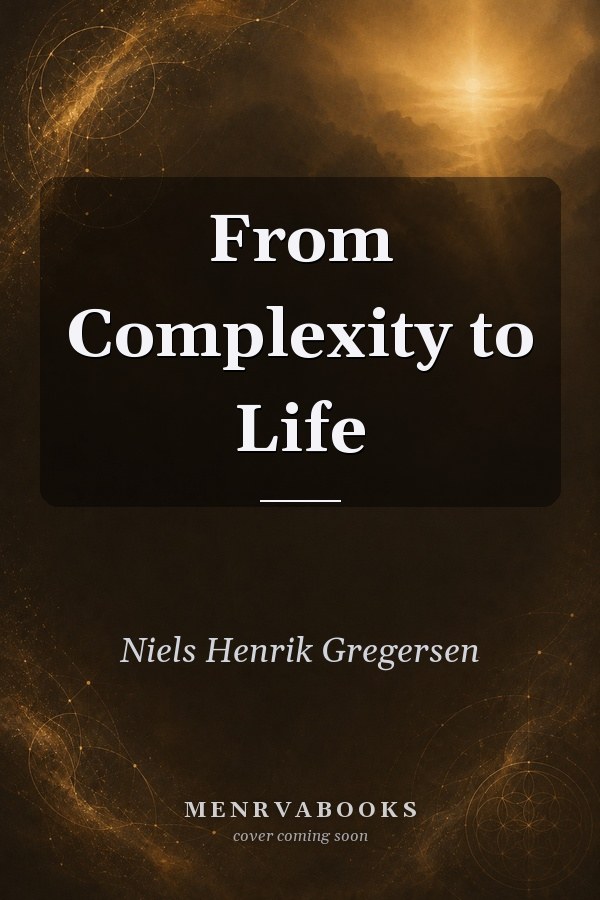
From Complexity to Life: On the Emergence of Life and Meaning
0
0
As an Amazon Associate and affiliate partner, Menrva Books earns from qualifying purchases. Learn more
Author Description
This book brings together an impressive group of leading scholars in the sciences of complexity, and a few workers on the interface of science and religion, to explore the wider implications of complexity studies. It includes an introduction to complexity studies and explores the concept of information in physics and biology and various philosophical and religious perspectives. Chapter authors include Paul Davies, Greg Chaitin, Charles Bennett, Werner Loewenstein, Paul Dembski, Ian Stewart, Stuart Kauffman, Harold Morowitz, Arthur Peacocke, and Niels H. Gregersen.
Menrva's Summary
THE THESIS
This volume investigates the ontological and teleological implications of complexity theory regarding the emergence of life and the nature of meaning. Editor Niels Henrik Gregersen assembles a multidisciplinary cohort of physicists, biologists, and theologians to evaluate how information-based systems in the natural world bridge the gap between physical processes and conscious experience. The text serves as a bridge between rigorous scientific inquiry and metaphysical reflection, utilizing the framework of complexity studies to re-examine traditional boundaries between matter and spirit.
THE SCOPE MAP
What You Will Find
- Theoretical foundations of complexity studies and self-organizing systems
- Analysis of information theory as applied to biological and physical phenomena
- Philosophical and theological critiques of reductionist scientific models
- Contributions from prominent figures including Paul Davies, Greg Chaitin, and Stuart Kauffman
Scope Limits
- Does not provide a unified theory of everything, but rather a collection of diverse disciplinary perspectives
- Lacks a singular, cohesive religious or scientific dogma, focusing instead on exploratory dialogue
THE AUTHORITY PERSPECTIVE
Scholars and students of science-religion dialogue frequently cite this work as a valuable interdisciplinary resource for understanding the intersection of information theory and biological emergence. Readers often note the academic density of the prose, which requires a foundational understanding of both complexity science and philosophical discourse to fully appreciate the arguments presented.
Page Count:
255
Publication Date:
2002-01-01
Publisher:
Oxford University Press
ISBN-10:
0190287861
ISBN-13:
9780190287863
Religion
Science
Philosophy
Evolution
Biology
Physics
Complexity Philosophy
English & College Success
Complexity Theory
Earth Sciences
English
Linguistics
Information Theory
Community Tags
Similar Books