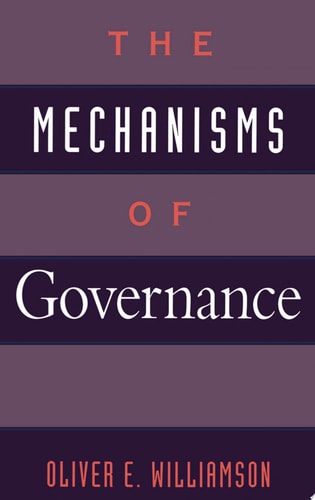
The Mechanisms of Governance
0
0
As an Amazon Associate and affiliate partner, Menrva Books earns from qualifying purchases. Learn more
Author Description
This book brings together in one place the work of one of our most respected economic theorists, on a field in which he has played a large part in originating: the New Institutional Economics. Transaction cost economics, which studies the governance of contractual relations, is the branch of the New Institutional Economics with which Oliver Williamson is especially associated.Transaction cost economics takes issue with one of the fundamental building blocks in microeconomics: the theory of the firm. Whereas orthodox economics describes the firm in technological terms, as a production function, transaction cost economics describes the firm in organizational terms, as a governance structure. Alternative feasible forms of organization--firms, markets, hybrids, bureaus--are examined comparatively. The analytical action resides in the details of transactions and the mechanisms of governance.Transaction cost economics has had a pervasive influence on current economic thought about how and why institutions function as they do, and it has become a practical framework for research in organizations by representatives of a variety of disciplines. Through a transaction cost analysis, The Mechanisms of Governance shows how and why simple contracts give way to complex contracts and internal organization as the hazards of contracting build up. That complicates the study of economic organization, but a richer and more relevant theory of organization is the result. Many testable implications and lessons for public policy accrue to this framework. Applications of both kinds are numerous and growing.Written by one of the leading economic theorists of our time, The Mechanisms of Governance is sure to be an important work for years to come. It will be of interest to scholars and students of economics, organization, management, and law.
Menrva's Summary
THE THESIS
This book investigates the fundamental question of how and why institutions function by replacing the traditional technological view of the firm with a governance-based framework. Oliver E. Williamson, a prominent economic theorist, utilizes the principles of New Institutional Economics to analyze the complexities of contractual relations. By focusing on transaction cost economics, the author provides a rigorous analytical structure that evaluates how firms, markets, and hybrids operate under varying degrees of contracting hazards. The text argues that understanding economic organization requires a shift toward examining the specific mechanisms that govern transactions.
THE SCOPE MAP
What You Will Find
- Comparative analysis of organizational forms including firms, markets, hybrids, and bureaus
- Theoretical framework for transaction cost economics and its application to the theory of the firm
- Examination of the transition from simple to complex contracts based on contracting hazards
- Empirical implications for public policy and organizational management
THE AUTHORITY PERSPECTIVE
Experts recognize this work as a foundational text for understanding the evolution of New Institutional Economics and the governance of contractual relations. Readers frequently note the academic density of the prose, which serves as a primary resource for scholars and students in the fields of economics, law, and management.
Page Count:
448
Publication Date:
1999-03-18
Publisher:
Oxford University Press
ISBN-10:
0195132602
ISBN-13:
9780195132601
Economics
Business
Corporate governance
Management
Economic Theory
Macroeconomic Theory
Organizational Theory
Community Tags
Other Editions(3)

Similar Books




Reader Comments
Share Your Thoughts
No comments yet. Be the first to share your thoughts!