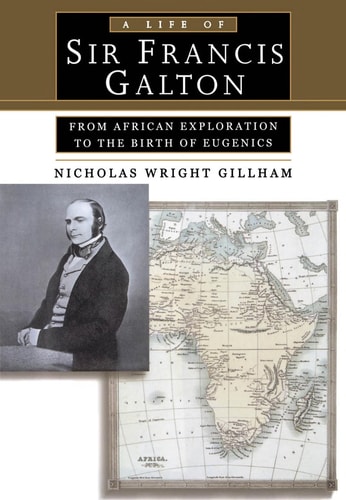
A Life of Sir Francis Galton: From African Exploration to the Birth of Eugenics
0
0
As an Amazon Associate and affiliate partner, Menrva Books earns from qualifying purchases. Learn more
Author Description
Few scientists have made lasting contributions to as many fields as Francis Galton. He was an important African explorer, travel writer, and geographer. He was the meteorologist who discovered the anticyclone, a pioneer in using fingerprints to identify individuals, the inventor of regression and correlation analysis in statistics, and the founder of the eugenics movement. Now, Nicholas Gillham paints an engaging portrait of this Victorian polymath.The book traces Galton's ancestry (he was the grandson of Erasmus Darwin and the cousin of Charles Darwin), upbringing, training as a medical apprentice, and experience as a Cambridge undergraduate. It recounts in colorful detail Galton's adventures as leader of his own expedition in Namibia. Darwin was always a strong influence on his cousin and a turning point in Galton's life was the publication of the Origin of Species. Thereafter, Galton devoted most of his life to human heredity, using then novel methods such as pedigree analysis and twin studies to argue that talent and character were inherited and that humans could be selectively bred to enhance these qualities. To this end, he founded the eugenics movement which rapidly gained momentum early in the last century. After Galton's death, however, eugenics took a more sinister path, as in the United States, where by 1913 sixteen states had involuntary sterilization laws, and in Germany, where the goal of racial purity was pushed to its horrific limit in the "final solution." Galton himself, Gillham writes, would have been appalled by the extremes to which eugenics was carried.Here then is a vibrant biography of a remarkable scientist as well as a superb portrait of science in the Victorian era.
Menrva's Summary
THE THESIS
How did the multifaceted scientific contributions of Francis Galton, ranging from meteorology to statistics, intersect with his controversial development of the eugenics movement? Nicholas W. Gillham, a biologist and historian, utilizes primary source materials and historical context to examine Galton's life as a Victorian polymath. The book argues that while Galton's intellectual curiosity drove significant advancements in modern statistics and identification, his focus on human heredity led to the creation of a movement that was later distorted by political and social extremes. Gillham provides a balanced view of Galton's personal development, his relationship with Charles Darwin, and the eventual historical consequences of his theories.
THE SCOPE MAP
What You Will Find
- Detailed examination of Victorian-era scientific exploration and geographical discovery in Namibia.
- Analysis of Galton's methodological innovations in statistics, including regression and correlation.
- Historical documentation of the rise of eugenics and its subsequent application in the United States and Germany.
- Biographical account of Galton's lineage, including his connection to the Darwin family.
THE AUTHORITY PERSPECTIVE
Experts and historians recognize this work as a comprehensive and objective biographical study of a complex scientific figure. Readers frequently note the clarity with which Gillham navigates the tension between Galton's legitimate scientific achievements and the problematic legacy of his eugenics research.
Page Count:
432
Publication Date:
2001-11-01
Publisher:
Oxford University Press
ISBN-10:
0195143655
ISBN-13:
9780195143652
Science
History
Biography
Geneticists
Eugenics
Genetics
Victorian Era
Community Tags
Similar Books