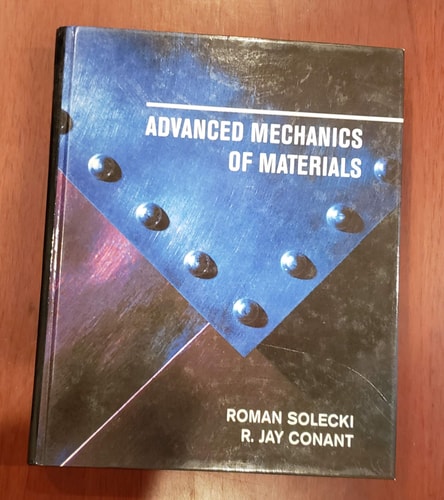
Advanced Mechanics of Materials
0
0
As an Amazon Associate and affiliate partner, Menrva Books earns from qualifying purchases. Learn more
Author Description
Advanced Mechanics of Materials bridges the gap between elementary mechanics of materials courses and more rigorous graduate courses in mechanics of deformable bodies (i.e., continuum mechanics, elasticity, plasticity) taken by graduate students. Covering both traditional and modern topics, the text is ideal for senior undergraduate and beginning graduate courses in advanced strength of materials, advanced mechanics of materials, or advanced mechanics of solids. Rather than exclusively emphasizing either fundamentals or applications, it provides a balance between the two, teaching fundamentals while using real-world applications to solidify student comprehension.Advanced Mechanics of Materials features: · applications to contemporary practice · use of modern computer tools, including Mathcad · an introduction to modern topics, such as piezoelectricity, fracture mechanics, and viscoelasticityChapters two through five cover theoretical and conceptual development and contain relatively simple examples aimed at enhancing student understanding. The remaining chapters apply the theory to specific classes of problems such as: · beam bending, including the effects of piezoelectricity · plate bending · beam and plate vibration and buckling · introductory concepts of fracture mechanics · finite element analysisThe authors assume that students will have an understanding of elementary (statics, dynamics, strength of materials) and intermediate (aircraft structures, machine design) mechanics.
Menrva's Summary
THE THESIS
This text investigates the transition from elementary mechanics of materials to the rigorous study of deformable bodies required for advanced engineering analysis. Authors R. Jay Conant and Roman Solecki provide a structured framework that balances theoretical foundations with contemporary industrial applications. By integrating modern computational tools and specialized topics, the text prepares senior undergraduates and graduate students for complex problem-solving in solid mechanics.
THE SCOPE MAP
What You Will Find
- Theoretical development of continuum mechanics, elasticity, and plasticity.
- Practical integration of Mathcad for computational analysis.
- Specialized modules on piezoelectricity, fracture mechanics, and viscoelasticity.
- Applied problem sets covering beam bending, plate vibration, and finite element analysis.
THE AUTHORITY PERSPECTIVE
Experts identify this text as a bridge between undergraduate fundamentals and graduate-level continuum mechanics. Readers frequently note the balance between conceptual development and the application of modern numerical tools in professional engineering contexts.
Page Count:
780
Publication Date:
2003-02-06
Publisher:
Oxford University Press
ISBN-10:
0195143728
ISBN-13:
9780195143720
Engineering
Mechanics
Strength of materials
textbook
Physics
Community Tags
Similar Books