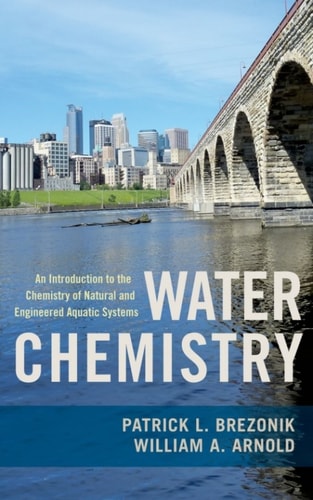
Water Chemistry: An Introduction to the Chemistry of Natural and Engineered Aquatic Systems
0
0
As an Amazon Associate and affiliate partner, Menrva Books earns from qualifying purchases. Learn more
Author Description
Water Chemistry provides students with the tools necessary to understand the processes that control the chemical species present in waters of both natural and engineered systems. After providing basic information about water itself and the chemical composition of water in environmental systems, the text covers the necessary theory (thermodynamics, activity, and kinetics) and background material to solve problems. It emphasizes that both equilibrium and kinetic processes are important in aquatic systems. The book does not merely focus on inorganic constituents, but also on the fate and reactions of organic chemicals.The solving of quantitative equilibrium and kinetic problems using mathematical, graphical, and computational tools is emphasized throughout presentations on acid-base chemistry, complexation of metal ions, solubility of minerals, and oxidation-reduction reactions. The use of these problem-solving tools is then extended in the presentation of topics relevant to natural systems, including dissolved oxygen, nutrient chemistry, geochemical controls on chemical composition, photochemistry, and natural organic matter. The kinetics and equilibria relevant to engineered systems (e.g., chlorination and disinfection chemistry, sorption and surface chemistry) and organic contaminant chemistry are also discussed. Numerous in-chapter examples that show the application of theory and demonstrate how problems are solved using algebraic, graphical, and computer-based techniques are included. Examples are relevant to both natural waters and engineered systems.
Menrva's Summary
THE THESIS
This text investigates the fundamental chemical processes that govern the composition and behavior of water within both natural environments and engineered aquatic systems. Authors Patrick L. Brezonik and William A. Arnold provide a comprehensive framework that integrates thermodynamics, kinetics, and chemical equilibrium to analyze water quality. By bridging theoretical chemistry with practical application, the authors equip students and professionals with the mathematical and computational tools required to solve complex environmental problems.
THE SCOPE MAP
What You Will Find
- Comprehensive coverage of thermodynamics, activity, and kinetic theory in aquatic environments.
- Quantitative methodologies for solving problems related to acid-base chemistry, metal ion complexation, and solubility.
- Analysis of both inorganic constituents and the fate of organic chemicals in water systems.
- Practical applications for engineered systems including chlorination, disinfection, and surface chemistry.
THE AUTHORITY PERSPECTIVE
Experts and educators recognize this work as a rigorous, foundational text for students in environmental engineering and aquatic chemistry. Readers frequently note the high level of technical detail and the utility of the included computational problem-solving examples.
Page Count:
808
Publication Date:
2011-01-01
Publisher:
Oxford University Press
ISBN-10:
019981354X
ISBN-13:
9780199813544
Science
Chemistry
Hydrology
Water Chemistry
Earth Sciences
Civil Engineering
Professional Career & Trade
Geology
Engineering
Community Tags
Similar Books