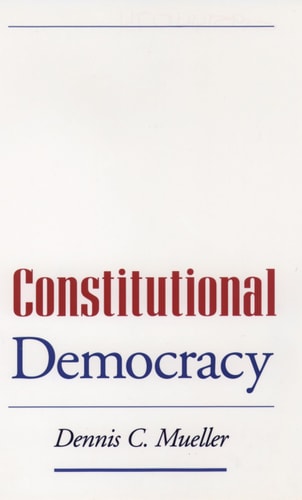
Constitutional Democracy
0
0
As an Amazon Associate and affiliate partner, Menrva Books earns from qualifying purchases. Learn more
Author Description
This volume systematically examines how the basic constitutional structure of governments affects what they can accomplish. At a time when Americans are more and more disillusioned about government's fundamental ability to reach solutions for domestic problems, and when countries in the former Soviet block and around the world are rewriting their constitutions, the relationship between government and constitution is especially important. Political economist Dennis Mueller illuminates the links between the structure of democratic government and its outcomes by drawing comparisons between the American system and other systems around the world. Working from the "public choice" perspective in political science, the book analyzes electoral rules, voting rules, federalism, citizenship, and separation of powers, making it a valuable resource for anyone curious about the world's political environment.
Menrva's Summary
THE THESIS
This volume investigates how the fundamental constitutional architecture of a government dictates its capacity to address domestic policy challenges and achieve effective governance. Dennis C. Mueller, a prominent political economist, utilizes the public choice framework to evaluate the efficacy of various democratic structures. By synthesizing comparative data from the United States and international systems, he argues that constitutional rules are the primary determinants of political outcomes and government performance.
THE SCOPE MAP
What You Will Find
- Comparative analysis of electoral and voting rules across diverse global systems.
- Examination of the impact of federalism and the separation of powers on policy outcomes.
- Application of public choice theory to evaluate democratic institutional design.
- Analysis of citizenship and constitutional frameworks in the context of post-Soviet political transitions.
THE AUTHORITY PERSPECTIVE
Experts recognize this work as a rigorous application of public choice theory to the study of constitutional design. Readers frequently note the academic density of the prose, which serves as a foundational text for students and scholars of political economy.
Page Count:
400
Publication Date:
2000-11-30
Publisher:
Oxford University Press
ISBN-10:
0195144074
ISBN-13:
9780195144079
Economics
United States
Government
Comparative Government
Constitutional Law
Representative government and representation
Community Tags
Similar Books