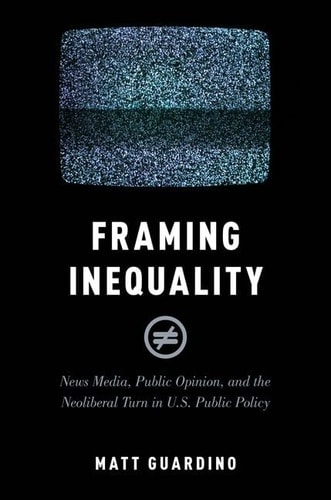
Framing Inequality: News Media, Public Opinion, and the Neoliberal Turn in U.S. Public Policy
0
0
As an Amazon Associate and affiliate partner, Menrva Books earns from qualifying purchases. Learn more
Author Description
Neoliberal policy approaches have swept over the American political economy in recent decades. In Framing Inequality, Matt Guardino focuses on the power of corporate news media in shaping how the public understands the pivotal policy debates of this period. Drawing on a wide range of empirical evidence from the dawn of the Reagan era into the Trump administration, he explains how profit pressures and commercial imperatives in the media have narrowed and trivialized news coverage and influenced public attitudes in the process. Guardino highlights how the political-economic structure of mainstream media operates to magnify some political messages and to mute or shut out others. He contends that news framing of policies that contribute to economic inequality has been unequal, and that this has undermined Americans' opportunities to express their views on an equal basis. Framing Inequality is a unique study that offers critical understanding of not only how neoliberalism succeeded as a political project, but also how Americans might begin to build a more democratic and egalitarian media system.
Menrva's Summary
THE THESIS
This book investigates how the structural imperatives of corporate news media have influenced public opinion and facilitated the rise of neoliberal policy in the United States. Matt Guardino, a political scientist, utilizes a longitudinal analysis of media coverage from the Reagan era through the Trump administration to demonstrate how commercial pressures constrain political discourse. He argues that the media's tendency to prioritize specific economic narratives has systematically marginalized egalitarian perspectives, thereby undermining democratic participation in policy debates.
THE SCOPE MAP
What You Will Find
- Longitudinal analysis of U.S. news media coverage from the 1980s to the present.
- Examination of the relationship between corporate profit pressures and news framing.
- Empirical evidence linking media content to shifts in public attitudes toward economic inequality.
- Theoretical framework for evaluating the democratic potential of media systems.
Scope Limits
- The study focuses primarily on mainstream corporate news outlets rather than independent or digital-native media.
- It does not provide a comprehensive history of all U.S. economic policy, focusing instead on those influenced by neoliberal shifts.
THE AUTHORITY PERSPECTIVE
Scholars in political communication and media studies recognize this work as a rigorous examination of the intersection between media structure and political inequality. Readers frequently note the academic density of the prose and the depth of the empirical data provided to support the author's claims.
Page Count:
328
Publication Date:
2019-03-13
Publisher:
Oxford University Press
ISBN-10:
0190888199
ISBN-13:
9780190888190
Economics
Liberalism
Media Studies
United States
Sociology
Public opinion
American History
Comparative Politics
Public Policy
Community Tags
Similar Books