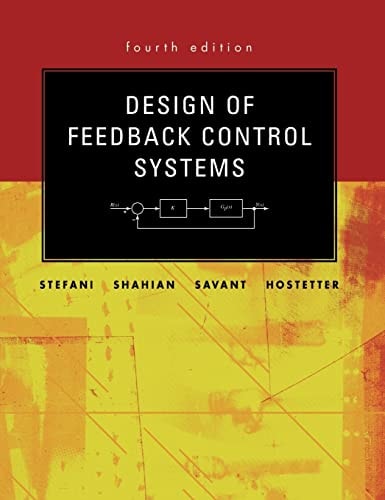
Design of Feedback Control Systems
0
0
As an Amazon Associate and affiliate partner, Menrva Books earns from qualifying purchases. Learn more
Author Description
Design of Feedback Control Systems is designed for electrical and mechanical engineering students in advanced undergraduate control systems courses. Now in its fourth edition, this tutorial-style textbook has been completely updated to include the use of modern analytical software, especially MATLAB®. It thoroughly discusses classical control theory and state variable control theory, as well as advanced and digital control topics. Each topic is preceded by analytical considerations that provide a well-organized parallel treatment of analysis and design. Design is presented in separate chapters devoted to root locus, frequency domain, and state space viewpoints. Treating the use of computers as a means rather than as an end, this student-friendly book contains new "Computer-Aided Learning" sections that demonstrate how MATLAB® can be used to verify all figures and tables in the text. Clear and accessible, Design of Feedback Control Systems, Fourth Edition, makes complicated methodology comprehensible to a wide spectrum of students.FeaturesBL Keyed to today's dominant design tool, MATLAB®BL Includes drill problems for gauging knowledge and skills after each topicBL Provides state-of-the-art design examplesBL Uses marginal summaries to guide the readerBL Introduces new ideas in the context of previous material, with a guide to the information that followsBL Presents practical examples of the latest advances in control sciences
Menrva's Summary
THE THESIS
This text investigates the fundamental principles and practical methodologies required for the design and analysis of feedback control systems in electrical and mechanical engineering. The authors, a team of experienced engineering educators, utilize a structured pedagogical approach to bridge the gap between classical control theory and modern state-variable techniques. By integrating analytical theory with contemporary computational tools, the book provides a comprehensive framework for students to master both the mathematical foundations and the applied design processes necessary for professional engineering practice.
THE SCOPE MAP
What You Will Find
- Comprehensive coverage of classical control theory, frequency domain analysis, and state space viewpoints.
- Integration of MATLAB software as a primary tool for verifying analytical results and modeling system responses.
- Pedagogical features including marginal summaries, drill problems, and step-by-step design examples.
- Advanced topics covering digital control systems and modern analytical design considerations.
THE AUTHORITY PERSPECTIVE
Experts and educators frequently cite this text as a foundational resource for undergraduate engineering curricula due to its clear, tutorial-style prose. The inclusion of computer-aided learning sections is widely recognized as a significant benefit for students transitioning from theoretical study to practical application.
Page Count:
864
Publication Date:
2001-08-30
Publisher:
Oxford University Press
ISBN-10:
0195142497
ISBN-13:
9780195142495
Engineering
Control systems
textbook
Electrical Engineering
Community Tags
Other Editions(2)
Similar Books