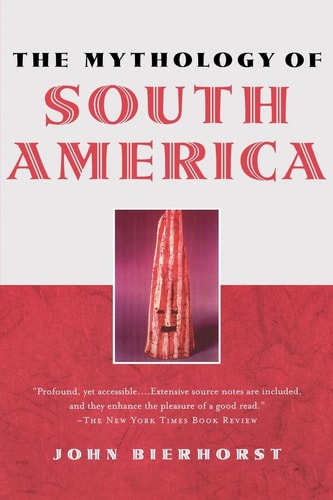
The Mythology of South America with a new afterword
0
0
As an Amazon Associate and affiliate partner, Menrva Books earns from qualifying purchases. Learn more
Author Description
More than any other continent, South America "has preserved the conditions that allow mythology to be freely produced." Dividing the continent into seven carefully mapped regions, John Bierhorst shows how South America's principal myths can be traced from tribe to tribe and how each region has developed its own unique oral tradition. Generous samples from the stories themselves introduce the female creators of the northern Andes, the male gods of the ancient Incas, and the Brazilian tricksters Sun and Moon. Originally published in 1988, Bierhorst has updated the text to reflect the abundance of new information that has become available since the mid 80s and written a new Afterword in which he emphasizes the durability of Indian mythology. Illustrations of native artwork and chapters devoted to special topics--including the connections between myths and politics--help to provide a well-rounded overview of this fascinating and little-known lore.Detailed maps show tribal locations and the distribution of key stories and samples of differing narrative styles add enrichment, as some of the world's purest and most powerful myths are made more accessible--and more meaningful--than ever before.
Menrva's Summary
THE THESIS
This work investigates the structural distribution and thematic evolution of South American indigenous mythology across diverse tribal regions. John Bierhorst, an established scholar of Native American folklore, utilizes a comparative framework to analyze how oral traditions persist and adapt within specific geographic and cultural contexts. By synthesizing ethnographic data with primary narrative samples, the author argues that South American mythology remains a dynamic, living system rather than a static historical artifact.
THE SCOPE MAP
What You Will Find
- A regional classification system dividing South America into seven distinct mythological zones.
- Comparative analysis of narrative motifs, including trickster figures and creator deities.
- Integration of primary source oral narratives alongside scholarly interpretation.
- Cartographic data mapping tribal locations and the geographic distribution of specific myths.
THE AUTHORITY PERSPECTIVE
Scholars and students of folklore frequently cite this text as a foundational resource for understanding the breadth of South American oral traditions. Readers often note that the prose remains accessible while providing the academic rigor necessary for serious study of the region's cultural history.
Page Count:
296
Publication Date:
2002-08-22
Publisher:
Oxford University Press
ISBN-10:
0195146255
ISBN-13:
9780195146257
Anthropology
Mythology
Folklore
Community Tags
Similar Books