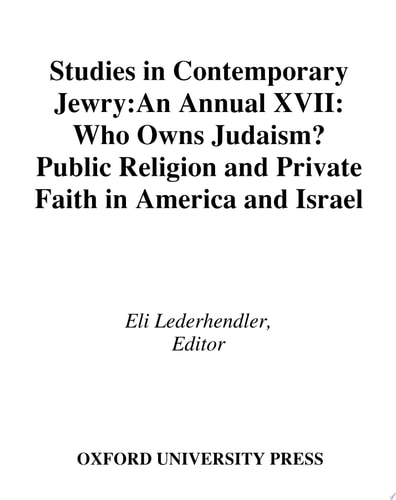
Studies in Contemporary Jewry: Volume XVII: Who Owns Judaism? Public Religion and Private Faith in America and Israel
0
0
As an Amazon Associate and affiliate partner, Menrva Books earns from qualifying purchases. Learn more
Author Description
Bringing together contributions from established scholars as well as promising younger academics, the seventeenth volume of this established series offers a broad-ranging view of why Judaism, a religion whose observance is more honored in the breach in most western Jewish communities, has garnered attention, authority, and controversy in the late twentieth century. The volume considers the ways in which theological writings, sweeping social change, individual or small-group needs, and intra-communal diversity have re-energized Judaism even amidst secular trends in America and Israel.
Menrva's Summary
THE THESIS
This volume investigates the paradox of why Judaism has gained increased social and political authority in the late twentieth century despite widespread secularization in American and Israeli societies. Eli Lederhendler, a scholar of modern Jewish history, compiles a collection of essays that examine the intersection of theological discourse, shifting social structures, and individual religious expression. The text argues that the re-energization of Jewish identity is not a monolithic trend but a complex negotiation between public institutional power and private faith practices.
THE SCOPE MAP
What You Will Find
- Comparative analysis of Jewish religious life in the United States and Israel.
- Examination of the tension between institutional authority and individual observance.
- Case studies on the impact of social change on traditional religious practice.
- Scholarly perspectives on the role of theological writing in modern public discourse.
THE AUTHORITY PERSPECTIVE
Experts recognize this volume as a significant contribution to the ongoing academic discourse regarding modern Jewish identity and institutional sociology. Readers frequently note the academic density of the prose, which serves as a foundational resource for researchers focusing on the intersection of religion and state in the late twentieth century.
Page Count:
320
Publication Date:
2001-12-20
Publisher:
Oxford University Press
ISBN-10:
0195148029
ISBN-13:
9780195148022
History
Religion
Judaism
Antisemitism
Sociology
Jews
Jews intellectual life
Academic
Books reviews
Politics & Government