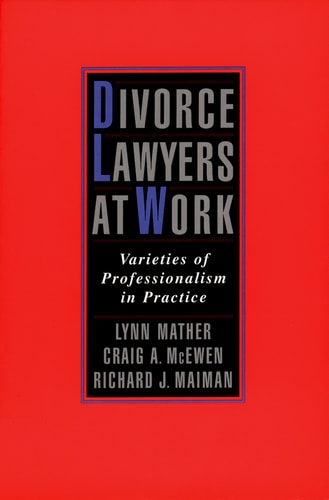
Divorce Lawyers at Work: Varieties of Professionalism in Practice
0
0
As an Amazon Associate and affiliate partner, Menrva Books earns from qualifying purchases. Learn more
Author Description
How do lawyers think about and make the important decisions that constitute the day-to-day practice of law? This book explores that question through an extensive empirical study of lawyers practicing divorce law in New England. The authors emphasize the importance of "collegial control" in shaping lawyers' decisions and identify a variety of "communities of practice" that serve as key agents of that control.Offering a new understanding of the nature of lawyers' work in divorce law as well as a new perspective on legal professionalism, this book is required reading for scholars, students, and practitioners.
Menrva's Summary
THE THESIS
This book investigates how divorce lawyers navigate professional decision-making and ethical standards within the day-to-day realities of their practice. The authors, Craig A. McEwen, Lynn Mather, and Richard J. Maiman, utilize extensive empirical data gathered from legal practitioners in New England to analyze the influence of professional norms. They argue that "collegial control" and specific "communities of practice" are the primary mechanisms that shape how attorneys approach their work and manage client expectations.
THE SCOPE MAP
What You Will Find
- Empirical study of divorce law practice in New England
- Analysis of the concept of collegial control in legal environments
- Identification of distinct communities of practice among attorneys
- Examination of professional decision-making processes in high-stakes litigation
THE AUTHORITY PERSPECTIVE
Experts and legal scholars recognize this work as a foundational text for understanding the sociological dimensions of legal practice. Readers frequently note the academic rigor of the research and its utility in explaining the informal pressures that govern attorney behavior.
Page Count:
256
Publication Date:
2001-09-13
Publisher:
Oxford University Press
ISBN-10:
019514516X
ISBN-13:
9780195145168
Law
Legal Studies
United States
Professionalism
Sociology
Community Tags
Similar Books