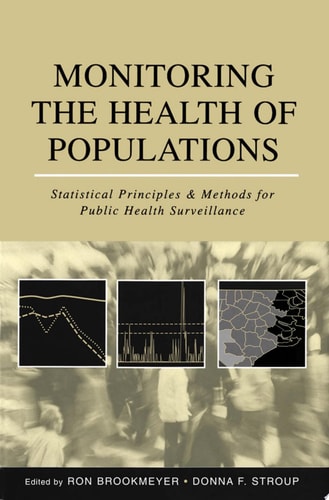
Monitoring the Health of Populations: Statistical Principles and Methods for Public Health Surveillance
0
0
As an Amazon Associate and affiliate partner, Menrva Books earns from qualifying purchases. Learn more
Author Description
Public health faces critical challenges ranging from outbreaks of new and old pathogens to the threat of bioterrorism and the impact of lifestyle and environmental changes on health. Modern tools of health surveillance and sound statistical practices are essential for meeting these challenges and providing accurate warnings about real public health threats without wasting resources on false alarms. Advances in statistical techniques, computing power and the Internet have led to many new approaches to monitoring population health, analyzing the data, and rapidly sharing it.This text explores the critical issues in the statistical analysis and interpretation of public health surveillance data. It covers statistical methods for detecting disease outbreaks and clusters, the use of survey methods, interpreting time trends and geographic patterns, exploratory statistical analysis of surveillance data, and web-based health reporting systems for the rapid detection of public health problems, among other topics. The methodological approaches are illustrated in discussions of several current public health issues, including the HIV/AIDS epidemic, anthrax, health effects of particulate air pollution, and trends in prostate cancer. The methods are broadly applicable to surveillance systems and registries for numerous health conditions, e.g. infectious diseases, chronic diseases, adverse drug reactions.The book provides numerous illustrations, worked examples, and practical information for actually implementing the methods. It will serve as a reference for public health practitioners and as a textbook for courses on disease surveillance taken by students of statistics biostatistics, epidemiology or public health.
Menrva's Summary
THE THESIS
This text investigates the statistical principles and methodological frameworks required to effectively monitor population health and detect public health threats. Authors Donna F. Stroup and Ron Brookmeyer leverage their expertise in biostatistics and epidemiology to provide a comprehensive guide for practitioners. The book argues that sound statistical practices, combined with modern computing and web-based reporting, are necessary to distinguish between genuine health crises and false alarms in an era of emerging pathogens and environmental change.
THE SCOPE MAP
What You Will Find
- Statistical methods for detecting disease outbreaks and geographic clusters.
- Analysis of time trends and exploratory statistical techniques for surveillance data.
- Practical implementation strategies for web-based health reporting systems.
- Case studies covering HIV/AIDS, anthrax, air pollution, and prostate cancer trends.
THE AUTHORITY PERSPECTIVE
Experts identify this work as a foundational reference for public health practitioners and students of biostatistics. Readers frequently note the technical density of the prose, which serves as a rigorous guide for implementing surveillance methodologies in real-world settings.
Page Count:
390
Publication Date:
2003-10-23
Publisher:
Oxford University Press
ISBN-10:
0195146492
ISBN-13:
9780195146493
Science
Epidemiology
Public Health
Medicine
Health Surveys
Biostatistics
Statistics
Community Tags
Similar Books