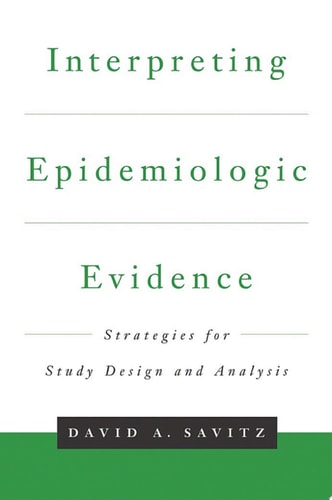
Interpreting Epidemiologic Evidence: Strategies for Study Design & Analysis
0
0
As an Amazon Associate and affiliate partner, Menrva Books earns from qualifying purchases. Learn more
Author Description
Evaluating the strength or persuasiveness of epidemiologic evidence is inherently challenging, both for those new to the field and for experienced researchers. There are a myriad of potential biases to consider, but little guidance about how to asses the likely impact on study results. This book offers a strategy for assessing epidemiologic research findings, explicitly describing the goals and products of epidemiologic research in order to better evaluate it successes and limitations. The focus throughout is on practical tools for making optimal use of available data to assess whether hypothesized biases are operative and to anticipate concerns at the point of study design in order to ensure that needed information is generated. Specific tools for assessing the presence and impact of selection bias in both cohort and case-control studies, bias from non-response, confounding, exposure measurement error, disease measurement error, and random error are identified and evaluated. The potential value of each approach as well as its limitations are discussed, using examples from the published literature. Such information should help those who generate and interpret epidemiologic research to apply methodological principles more effectively to substantive issues, leading to a more accurate appraisal of the current evidence and greater clarity about research needs.
Menrva's Summary
THE THESIS
This text investigates the core challenge of evaluating the strength and validity of epidemiologic evidence within scientific research. Author David A. Savitz, a seasoned epidemiologist, provides a structured framework for assessing study findings by identifying potential biases and offering practical tools to improve both study design and data interpretation.
THE SCOPE MAP
What You Will Find
- Methodologies for assessing selection bias in cohort and case-control studies
- Techniques for evaluating bias from non-response and confounding variables
- Analytical tools for addressing exposure measurement error, disease measurement error, and random error
- Practical applications using examples from published literature
Scope Limits
- The text focuses primarily on methodological assessment rather than broad public health policy implementation
- It assumes a baseline understanding of epidemiologic principles and terminology
THE AUTHORITY PERSPECTIVE
Experts and researchers frequently cite this work as a practical manual for navigating the complexities of bias in observational studies. Readers often note the technical density of the prose, which serves as a rigorous resource for those actively engaged in designing or critiquing epidemiologic research.
Page Count:
334
Publication Date:
2003-01-01
Publisher:
Oxford University Press
ISBN-10:
0190283106
ISBN-13:
9780190283100
Science
Medical
Public Health
Allied Health
Medicine
Biostatistics
Epidemiology
Statistics
Community Tags
Similar Books