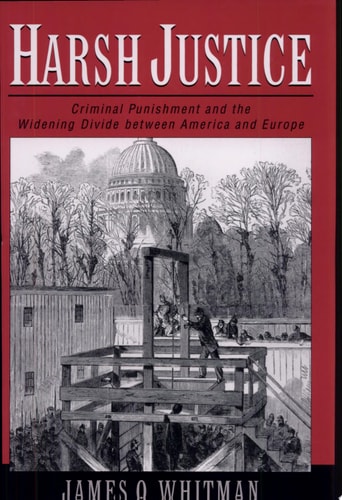
Harsh Justice: Criminal Punishment and the Widening Divide Between America and Europe
0
0
As an Amazon Associate and affiliate partner, Menrva Books earns from qualifying purchases. Learn more
Author Description
Why is American punishment so cruel? While in continental Europe great efforts are made to guarantee that prisoners are treated humanely, in America sentences have gotten longer and rehabilitation programs have fallen by the wayside. Western Europe attempts to prepare its criminals for life after prison, whereas many American prisons today leave their inhabitants reduced and debased. In the last quarter of a century, Europe has worked to ensure that the baser human inclination toward vengeance is not reflected by state policy, yet America has shown a systemic drive toward ever increasing levels of harshness in its criminal policies. Why is America so short on mercy? In this deeply researched, comparative work, James Q. Whitman reaches back to the 17th and 18th centuries to trace how and why American and European practices came to diverge. Eschewing the usual historical imprisonment narratives, Whitman focuses instead on intriguing differences in the development of punishment in the age of Western democracy. European traditions of social hierarchy and state power, so consciously rejected by the American colonies, nevertheless supported a more merciful and dignified treatment of offenders. The hierarchical class system on the continent kept alive a tradition of less-degrading "high-status" punishments that eventually became applied across the board in Europe. The distinctly American, draconian regime, on the other hand, grows, Whitman argues, out of America's longstanding distrust of state power and its peculiar, broad-brush sense of egalitarianism. Low-status punishments were evenly meted out to all offenders, regardless of class or standing. America's unrelentingly harsh treatment of transgressors--this "equal opportunity degradation"-- is, in a very real sense, the dark side of the nation's much vaunted individualism. A sobering look at the growing rift between the United States and Europe, Harsh Justice exposes the deep cultural roots of America's degrading punishment.
Menrva's Summary
THE THESIS
Why does the American criminal justice system exhibit significantly higher levels of harshness and lower levels of mercy compared to its Western European counterparts? James Q. Whitman, a professor of comparative law, utilizes historical analysis and legal theory to argue that the divergence in penal practices stems from differing cultural attitudes toward state power and social hierarchy. By examining the evolution of democratic ideals in the 17th and 18th centuries, the author demonstrates how European traditions of status-based dignity evolved into universal human rights, whereas American egalitarianism paradoxically fostered a system of equal-opportunity degradation.
THE SCOPE MAP
What You Will Find
- Comparative analysis of 17th and 18th-century penal development in the United States and Europe.
- Examination of how social hierarchy influenced the transition from status-based punishment to modern standards.
- Investigation into the impact of American distrust of state power on sentencing policies.
- Theoretical framework linking egalitarianism to the systemic increase in punitive measures.
THE AUTHORITY PERSPECTIVE
Legal scholars and historians frequently cite this work as a foundational text for understanding the cultural underpinnings of modern penal policy. Readers often note the academic density of the prose, which provides a rigorous, non-traditional perspective on the history of democratic governance and criminal justice.
Page Count:
336
Publication Date:
2003-03-27
Publisher:
Oxford University Press
ISBN-10:
0195155254
ISBN-13:
9780195155259
Politics
History
Punishment
Law
Kindle Store
Kindle eBooks
Criminal Law
Sociology
Categories
Criminology
Community Tags
Similar Books