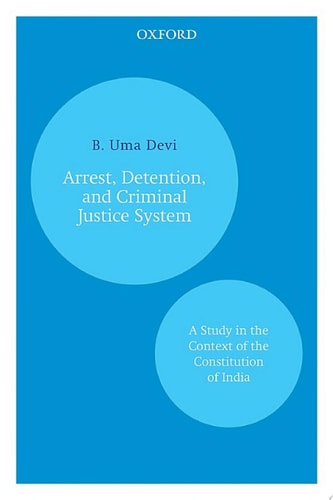
Arrest, Detention, and Criminal Justice System: A Study in the Context of the Constitution of India
0
0
As an Amazon Associate and affiliate partner, Menrva Books earns from qualifying purchases. Learn more
Author Description
A Just, Fair, Reasonable, And Purposeful Exercise Of Arrest And Detention Powers By The State Is Both In The Interest Of The Individual And The Society At Large. However, Very Often Individual Rights Are Impinged By Arbitrary And Illegal Exercise Of State Power To Arrest And Detain. The Book Studies Issues Pertaining To Arrest And Detention, Comprehensively, Critically, And Analytically, In The Light Of The Indian Constitution. It Points Out That The Arrest And Detention Provisions In The Legal System Of India, By And Large, Have Remained The Same As Inherited From The Imperial British Era. Despite Constitutional Prescriptions And Judicial Pronouncements Over Several Decades, There Has Been No Noteworthy Change That Would Bring The Law In Tune With The Constitutional Emphasis On Right To Life And Personal Liberty As Well As Other Human Rights. To Capture The Complexity Of The Issue, The Volume Analyses Constitutional Provisions, Statutory Law, Pertinent Judgments, Case Law, Reports Of Various Committees, And Recommendations Of Experts In The Field. Exploring Lacunae In The Present Legal Scenario, The Book Stresses On The Need For Organizational And Attitudinal Changes In The State Instrumentalities For Successfully Balancing The Need To Maintain Law And Order And Human Rights Imperatives. Emphasizing That It Is The Poor Who Often Suffer The Most, The Author Further Advocates Inclusion Of The Developments In The Field Of Jurisprudence, Behavioural Sciences, Technology, And Management To Deal With Crime And Criminality.
Menrva's Summary
THE THESIS
This book investigates the persistent tension between state-sanctioned arrest and detention powers and the fundamental rights of individuals as guaranteed by the Constitution of India. Author B. Uma Devi, a legal scholar, examines how colonial-era legal frameworks continue to dominate the Indian criminal justice system despite decades of constitutional development and judicial intervention. The work argues that the current system fails to adequately protect personal liberty, necessitating a shift in both organizational structure and institutional attitude to align with modern human rights standards.
THE SCOPE MAP
What You Will Find
- Analysis of constitutional provisions and statutory laws governing arrest and detention in India.
- Review of landmark judicial pronouncements and case law regarding personal liberty.
- Evaluation of committee reports and expert recommendations concerning criminal justice reform.
- Discussion on the intersection of jurisprudence, behavioral science, and technology in modern policing.
THE AUTHORITY PERSPECTIVE
Legal scholars and practitioners view this text as a critical examination of the systemic inertia within India's legal apparatus. The book is frequently cited for its rigorous synthesis of historical colonial influence and contemporary human rights imperatives.
Page Count:
428
Publication Date:
2012-01-01
Publisher:
OUP India
ISBN-10:
0199088632
ISBN-13:
9780199088638
Categories
Law
Kindle Store
Indian Law
Criminal Law
Constitutional Law
Kindle eBooks
Human rights
Community Tags
Similar Books