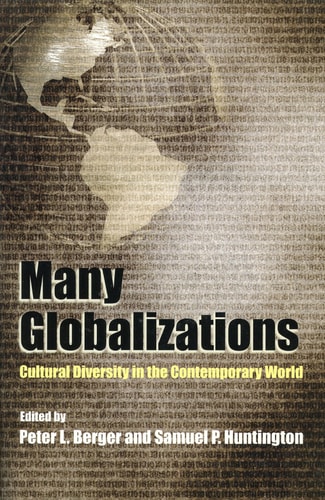
Many Globalizations: Cultural Diversity in the Contemporary World
0
0
As an Amazon Associate and affiliate partner, Menrva Books earns from qualifying purchases. Learn more
Author Description
Much discussed but poorly understood, globalization is praised as the answer to all the world's problems and blamed for everything from pollution to poverty. In Many Globalizations, Peter Berger and Samuel Huntington bring together an array of scholars from around the world, who paint a far subtler and more richly shaded portrait, showing both the power and the unexpected consequences of this great force.Here the stereotypes of globalization as American imperialism on the one hand or economic cure-all on the other fall apart under the close scrutiny of these leading scholars. Looking at globalization in countries such as Chile, Japan, South Africa, Germany, Turkey, Hungary, Taiwan, India, and the United States, they show that an emerging global culture does indeed exist, one that is heavily American in origin and content, but that is far from a centrally directed force like classic imperialism--nor is it simply a "metastasized Disneyland." They examine the currents that carry this culture, from a worldwide class of young professionals to nongovernmental organizations, and define globalization's many variations (ranging from Buddhist influences to Islamic modernism) as well as subglobalizations that bind regions together. The authors also draw attention to globalizing forces that have escaped media scrutiny, such as the role of evangelical Protestantism (which both adapts to local languages and cultures, and introduce distinctively American values) and Opus Dei, the conservative Catholic movement that originated in Spain.Analytical, incisive and stimulating, Many Globalizations offers rare insight into perhaps the central issue of modern times, one that is changing the West as much as the developing world.
Menrva's Summary
THE THESIS
This book investigates the multifaceted nature of globalization by challenging the binary view that it is either a universal economic panacea or a form of American cultural imperialism. Editors Peter L. Berger and Samuel P. Huntington assemble a diverse group of international scholars to analyze how global forces interact with local traditions. By examining specific case studies, the contributors argue that globalization is a complex, decentralized process that produces varied cultural outcomes rather than a monolithic, American-led transformation.
THE SCOPE MAP
What You Will Find
- Comparative analysis of globalization in Chile, Japan, South Africa, Germany, Turkey, Hungary, Taiwan, India, and the United States.
- Examination of cultural conduits including nongovernmental organizations and the international professional class.
- Investigation into the influence of religious movements such as evangelical Protestantism and Opus Dei.
- Theoretical framework distinguishing between global culture, subglobalizations, and local adaptations.
THE AUTHORITY PERSPECTIVE
Experts frequently cite this collection as a foundational text for understanding the cultural dimensions of globalization beyond mere economic metrics. Readers often note the academic rigor of the essays, which provide a nuanced perspective on how modern forces are reshaped by regional contexts.
Page Count:
374
Publication Date:
2002-06-06
Publisher:
Oxford University Press
ISBN-10:
0195151461
ISBN-13:
9780195151466
Sociology
Globalization
International relations
Community Tags
Other Editions(2)
Similar Books















Reader Comments
Share Your Thoughts
No comments yet. Be the first to share your thoughts!