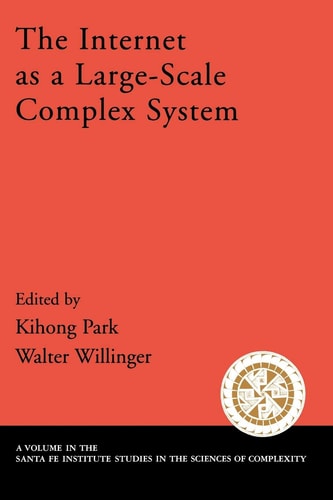
The Internet As a Large-Scale Complex System
0
0
As an Amazon Associate and affiliate partner, Menrva Books earns from qualifying purchases. Learn more
Author Description
The Internet may be viewed as a "complex system" with diverse features and many components that can give rise to unexpected emergent phenomena, revealing much about its own engineering. This book brings together chapter contributions from a workshop held at the Santa Fe Institute in March 2001. This volume captures a snapshot of some features of the Internet that may be fruitfully approached using a complex systems perspective, meaning using interdisciplinary tools and methods to tackle the subject area. The Internet penetrates the socioeconomic fabric of everyday life; a broader and deeper grasp of the Internet may be needed to meet the challenges facing the future.The resulting empirical data have already proven to be invaluable for gaining novel insights into the network's spatio-temporal dynamics, and can be expected to become even more important when tryin to explain the Internet's complex and emergent behavior in terms of elementary networking-based mechanisms. The discoveries of fractal or self-similar network traffic traces, power-law behavior in network topology and World Wide Web connectivity are instances of unsuspected, emergent system traits. Another important factor at the heart of fair, efficient, and stable sharing of network resources is user behavior. Network systems, when habited by selfish or greedy users, take on the traits of a noncooperative multi-party game, and their stability and efficiency are integral to understanding the overall system and its dynamics. Lastly, fault-tolerance and robustness of large-scale network systems can exhibit spatial and temporal correlations whose effective analysis and management may benefit from rescaling techniques applied in certain physical and biological systems. The present book will bring together several of the leading workers involved in the analysis of complex systems with the future development of the Internet.
Menrva's Summary
THE THESIS
This volume investigates the Internet as a large-scale complex system, questioning how interdisciplinary methods from physics and biology can explain the network's emergent behaviors and structural dynamics. Editors Kihong Park and Walter Willinger compile research from a 2001 Santa Fe Institute workshop, bringing together experts to analyze the intersection of networking engineering and complex systems theory. The text argues that traditional networking models are insufficient for understanding the Internet's self-similar traffic, power-law topology, and the socioeconomic implications of user behavior. By applying rescaling techniques and game theory, the authors provide a framework for analyzing the robustness and stability of global network infrastructures.
THE SCOPE MAP
What You Will Find
- Empirical analysis of fractal and self-similar network traffic patterns.
- Application of game theory to model user behavior and resource sharing.
- Examination of power-law distributions in network topology and web connectivity.
- Methodologies for assessing fault-tolerance and system robustness using physical and biological scaling techniques.
THE AUTHORITY PERSPECTIVE
Experts recognize this volume as a foundational interdisciplinary text that bridges the gap between traditional computer science and complex systems research. Readers frequently note the technical density of the prose, which assumes a strong background in mathematics and network engineering.
Page Count:
322
Publication Date:
2005-06-23
Publisher:
Oxford University Press
ISBN-10:
0195157214
ISBN-13:
9780195157215
Computer Science
Network Theory
Mathematics
Complex Systems
Physics
Internet
Community Tags
Similar Books