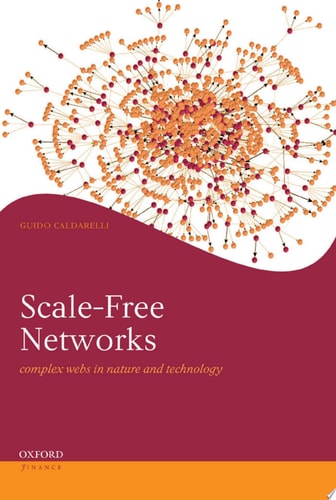
Scale-Free Networks: Complex Webs in Nature and Technology
0
0
As an Amazon Associate and affiliate partner, Menrva Books earns from qualifying purchases. Learn more
Author Description
A variety of different social, natural and technological systems can be described by the same mathematical framework. This holds from the Internet to food webs and to boards of company directors. In all these situations a graph of the elements of the system and their interconnections displays a universal feature. There are only few elements with many connections, and many elements with few connections. This book presents the experimental evidence of these "Scale-free networks" and provides students and researchers with a corpus of theoretical results and algorithms to analyse and understand these features. The content of this book and the exposition makes it a clear textbook for beginners, and a reference book for the experts.
Menrva's Summary
THE THESIS
This book investigates the universal mathematical framework that governs the structure of diverse social, natural, and technological systems characterized by scale-free properties. Guido Caldarelli, a researcher in complex systems, synthesizes experimental evidence and theoretical models to explain why systems ranging from the Internet to biological food webs exhibit a distribution where a few nodes possess a high number of connections while the majority possess very few. The text provides a structured approach for students and researchers to analyze these network topologies using established algorithms and statistical mechanics.
THE SCOPE MAP
What You Will Find
- Mathematical models of scale-free network growth and preferential attachment
- Empirical data sets from biological, social, and technological domains
- Algorithmic tools for calculating network properties and connectivity
- Comparative analysis of network robustness and vulnerability
Scope Limits
- Advanced specialized applications in niche fields outside of general network theory
- Historical development of graph theory prior to modern scale-free research
THE AUTHORITY PERSPECTIVE
Experts and academics frequently cite this work as a foundational text that bridges the gap between theoretical physics and practical network analysis. Readers often note that the prose maintains a balance between academic rigor and accessibility, making it suitable for both students entering the field and established researchers seeking a comprehensive reference.
Page Count:
309
Publication Date:
2007-01-01
Publisher:
OUP Oxford
ISBN-10:
0191526347
ISBN-13:
9780191526343
Science
Earth Sciences
Physics
Mathematics
Network Theory
Complex Systems
Mathematical Physics
Computer Science
Community Tags
Similar Books