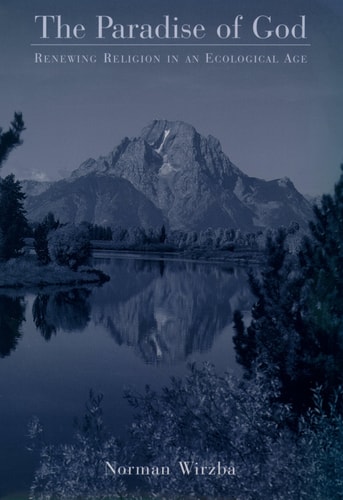
The Paradise of God: Renewing Religion in an Ecological Age
0
0
As an Amazon Associate and affiliate partner, Menrva Books earns from qualifying purchases. Learn more
Author Description
"And God said, Let us make man in our image, after our likeness: and let them have dominion over the fish of the sea, and over the fowl of the air, and over the cattle, and over all the earth, and over every creeping thing that creepeth upon the earth." (Gen. 1:26) It has become a commonplace that Biblical religion bears a heavy share of responsibility for our destruction of the environment, and this passage from the King James version of the Bible exemplifies what is generally believed to be the Biblical attitude toward the earth.In this provocative book, however, Norman Wirzba argues that the doctrine of creation, when understood as a statement about the moral and spiritual meaning of the world, actually holds the key to a true understanding of our place in the environment and our responsibility toward it. Wirzba contends that an adequate response to environmental destruction depends on a new formulation of ourselves as part of a created whole, rather than as autonomous, unencumbered individuals. Drawing on the work of biblical scholars, ecologists, agrarians, philosophers, theologians, and cultural critics, Wirzba develops a comprehensive worldview that grows out of the idea that the world is God's creation. While the text of Genesis has historically encouraged a vision of persons as masters of creation, a more theologically and ecologically sensitive rendering, he says, would be to say that we are servants of creation. Our present culture, Wirzba believes, results from a denial of creation that has caused modern problems as diverse as rootlessness, individualism, careerism, boredom, and consumerism. The recovery of the meaning of creation can lead to a renewed sense of human identity and vocation, and happier, more peaceful lives. He concludes by offering practical advice for individuals who wish to begin the work of transformation and renewal.Moving beyond the usual political debates, The Paradise of God presents a compelling vision of a new religious environment.
Menrva's Summary
THE THESIS
Can a renewed theological understanding of creation provide the necessary moral framework to address the modern ecological crisis? Norman Wirzba, a professor of theology and ecology, examines the historical interpretation of biblical dominion and argues that it has been fundamentally misunderstood. By synthesizing insights from agrarian studies, philosophy, and biblical scholarship, he proposes that humanity must shift its self-conception from masters of the earth to servants of a created whole to mitigate environmental destruction.
THE SCOPE MAP
What You Will Find
- A critical re-evaluation of the Genesis doctrine of creation and its impact on environmental ethics.
- An analysis of modern societal issues including consumerism, rootlessness, and individualism as symptoms of a denial of creation.
- Interdisciplinary research incorporating perspectives from ecologists, theologians, and cultural critics.
- Practical guidance for individuals seeking to transition toward a more sustainable and vocation-oriented lifestyle.
THE AUTHORITY PERSPECTIVE
Experts in the field of eco-theology identify this work as a significant contribution to the dialogue between religious tradition and environmental stewardship. Readers frequently note the accessible yet rigorous nature of the prose, which bridges the gap between academic theology and practical application for the layperson.
Page Count:
256
Publication Date:
2003-01-01
Publisher:
Oxford University Press
ISBN-10:
0195157168
ISBN-13:
9780195157161
Religion
Philosophy
Ecology
Creation
Christianity
Theology
Community Tags
Similar Books