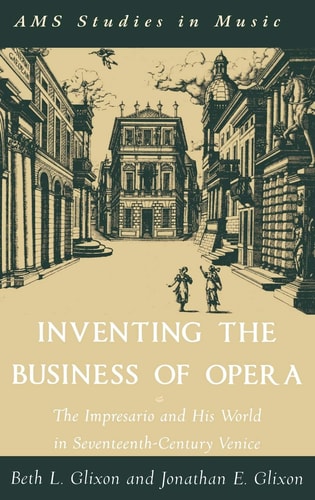
Inventing the Business of Opera: The Impresario and His World in Seventeenth-Century Venice
0
0
As an Amazon Associate and affiliate partner, Menrva Books earns from qualifying purchases. Learn more
Author Description
In mid seventeenth-century Venice, opera first emerged from courts and private drawing rooms to become a form of public entertainment. Early commercial operas were elaborate spectacles, featuring ornate costumes and set design along with dancing and music. As ambitious works of theater, these productions required not only significant financial backing, but also strong managers to oversee several months of rehearsals and performances. These impresarios were responsible for every facet of production from contracting the cast to balancing the books at season's end. The systems they created still survive, in part, today.Inventing the Business of Opera explores public opera in its infancy, from 1637 to 1677, when theater owners and impresarios established Venice as the operatic capital of Europe. Drawing on extensive new documentation, the book studies all of the components necessary to opera production, from the financial backing of various populations of Venice, to the commissioning and creation of the libretto and the score; the recruitment and employment of singers, dancers, and instrumentalists; the production of the scenery and the costumes, and, the nature of the audience; and, finally, the issue of patronage. Throughout the book, the problems faced by impresarios come into new focus. The authors chronicle the progress of Marco Faustini, the impresario most well known today, who made his way from one of Venice's smallest theaters to one of the largest. His companies provide the most personal view of an impresario and his partners, who ranged from Venetian nobles to artisans. Throughout the book, Venice emerges as a city that prized novelty over economy, with new repertory, scenery, costumes, and expensive singers the rule rather than the exception. The authors examine the challenges faced by four separate Venetian theaters during the seventeenth century: San Cassiano, the first opera theater, the Novissimo, the small Sant'Aponal, and San Luca, established in 1660.
Menrva's Summary
THE THESIS
This work investigates the emergence of commercial opera in seventeenth-century Venice by analyzing the role of the impresario as the primary architect of the industry. Authors Beth and Jonathan E. Glixon utilize archival documentation to reconstruct the economic and logistical frameworks that allowed opera to transition from private courtly entertainment to a public, profit-driven enterprise. By focusing on the period between 1637 and 1677, the authors argue that the business models established by these early managers created the foundational structures for modern theatrical production.
THE SCOPE MAP
What You Will Find
- Financial analysis of Venetian theater funding and patronage models.
- Detailed examination of the production lifecycle, including libretto commissioning, score creation, and casting.
- Case studies of four specific Venetian theaters: San Cassiano, Novissimo, Sant'Aponal, and San Luca.
- Biographical study of the impresario Marco Faustini and his professional network.
THE AUTHORITY PERSPECTIVE
Scholars and music historians recognize this text as a definitive resource for understanding the intersection of early modern economics and the arts. Readers frequently note the meticulous use of primary source documentation to demystify the logistical complexities of seventeenth-century Venetian opera production.
Page Count:
424
Publication Date:
2005-12-01
Publisher:
Oxford University Press
ISBN-10:
0195154169
ISBN-13:
9780195154160
Business
History
Music
European History
Community Tags
Similar Books





Reader Comments
Share Your Thoughts
No comments yet. Be the first to share your thoughts!