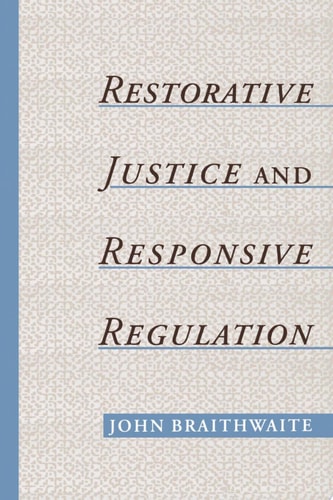
Restorative Justice & Responsive Regulation
0
0
As an Amazon Associate and affiliate partner, Menrva Books earns from qualifying purchases. Learn more
Author Description
Braithwaite's argument against punitive justice systems and for restorative justice systems establishes that there are good theoretical and empirical grounds for anticipating that well designed restorative justice processes will restore victims, offenders, and communities better than existing criminal justice practices. Counterintuitively, he also shows that a restorative justice system may deter, incapacitate, and rehabilitate more effectively than a punitive system. This is particularly true when the restorative justice system is embedded in a responsive regulatory framework that opts for deterrence only after restoration repeatedly fails, and incapacitation only after escalated deterrence fails. Braithwaite's empirical research demonstrates that active deterrence under the dynamic regulatory pyramid that is a hallmark of the restorative justice system he supports, is far more effective than the passive deterrence that is notable in the stricter "sentencing grid" of current criminal justice systems.
Menrva's Summary
THE THESIS
This work investigates whether restorative justice processes, when integrated into a responsive regulatory framework, can outperform traditional punitive criminal justice systems in terms of victim restoration and offender rehabilitation. John Braithwaite, a prominent scholar in criminology and sociology, utilizes extensive empirical research to challenge the efficacy of standard punitive models. He proposes a dynamic regulatory pyramid that prioritizes restorative outcomes, reserving deterrence and incapacitation as secondary measures to be employed only when initial restorative efforts fail. The book argues that this tiered approach provides a more robust mechanism for social control than the rigid sentencing grids currently favored in many jurisdictions.
THE SCOPE MAP
What You Will Find
- A comparative analysis between punitive justice systems and restorative justice models.
- The regulatory pyramid framework for escalating intervention strategies.
- Empirical evidence evaluating the effectiveness of deterrence versus restoration.
- Theoretical foundations for community-based conflict resolution and offender reintegration.
THE AUTHORITY PERSPECTIVE
Experts in the field of criminology frequently cite this text as a foundational contribution to the study of responsive regulation and restorative justice. Readers often note the academic density of the prose, which is intended for scholars, policymakers, and legal professionals seeking a rigorous theoretical framework for criminal justice reform.
Page Count:
336
Publication Date:
2002-10-24
Publisher:
Oxford University Press
ISBN-10:
0195158393
ISBN-13:
9780195158397
Law
Administration of Justice
Categories
Victims of crimes
Sociology
Kindle eBooks
Criminal Law
Professional Career & Trade
Kindle Store
Criminology
Public Policy
Community Tags
Other Editions(3)


Similar Books