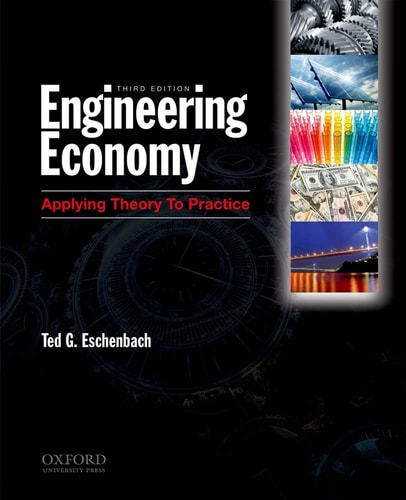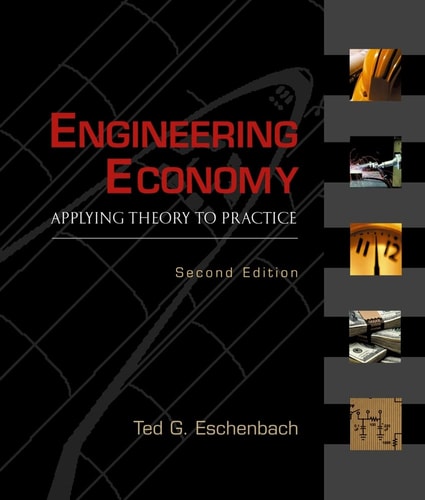
Engineering Economy: Applying Theory to Practice
0
0
As an Amazon Associate and affiliate partner, Menrva Books earns from qualifying purchases. Learn more
Author Description
Thoroughly revised in this second edition,Engineering Economy: Applying Theory to Practice combines real-world problems minicases, and examples with a solid theoretical foundation in engineering economy. This innovative book covers all the standard topics included in the Fundamentals of Engineering (FE) Exam. It clearly illustrates concepts and methods--such as cost estimating, sensitivity analysis, probability, and multiple objectives--needed for successful application of engineering economy in industry practice. In addition, fully integrated Excel spreadsheets throughout the text function as indispensable analytical tools for problem-solving and understanding. Engineering Economy: Applying Theory to Practice, 2/e, is a comprehensive introductory text suitable for upper-division undergraduate courses, graduate courses, or as a professional reference.NEW TO THE SECOND EDITION:BL Unique insight into using Excel functions for MACRS depreciationBL New problems, examples, references, illustrations, graphs, and tablesBL Minicase studies at the ends of most chaptersBL Improved coverage of replacement analysis, inflation, and sensitivity analysisBL An appendix on engineering economy-based accountingBL More accessible presentation of analyzing the defender in replacement problemsBL Discussion of geometric gradients unified with other engineering economy factorsBL Comparison of mutually exclusive alternatives now precedes the treatment of constrained project selection/capital budgeting
Menrva's Summary
THE THESIS
This text investigates the application of economic theory to engineering decision-making processes through a blend of foundational principles and practical industry-standard tools. Author Ted G. Eschenbach leverages his academic expertise to provide a comprehensive framework that bridges the gap between theoretical economic models and the realities of industrial project management. The book utilizes a structured approach to cost analysis, risk assessment, and capital budgeting, ensuring that readers can apply these methods to complex engineering problems. By integrating modern computational tools, the work serves as a bridge for students and professionals preparing for the Fundamentals of Engineering exam.
THE SCOPE MAP
What You Will Find
- Comprehensive coverage of cost estimating, sensitivity analysis, and probability models.
- Practical integration of Excel spreadsheets for financial modeling and depreciation calculations.
- Applied minicase studies designed to simulate real-world industrial decision-making scenarios.
- Detailed methodologies for replacement analysis, inflation adjustments, and capital budgeting.
THE AUTHORITY PERSPECTIVE
Experts and educators frequently identify this text as a foundational resource for upper-division undergraduate and graduate engineering curricula. Readers often note the technical density of the prose, which is balanced by the inclusion of accessible Excel-based analytical tools for professional application.
Page Count:
624
Publication Date:
2003-04-10
Publisher:
Oxford University Press
ISBN-10:
0195161521
ISBN-13:
9780195161526
Economics
Finance
textbook
Engineering
Reference