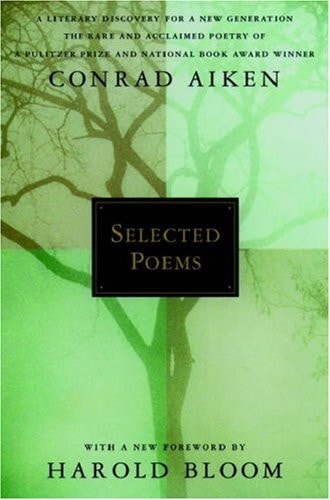
Selected Poems
0
0
As an Amazon Associate and affiliate partner, Menrva Books earns from qualifying purchases. Learn more
Author Description
Poet, short story writer, critic and novelist, Conrad Aiken (1889-1973) has been called the most metaphysical, the most learned, and the most modern of poets. With writing that reflects an intense interest in psychological, philosophical, and scientific issues, Aiken remains a unique influence upon modern writers and critics today. In his lifetime, Aiken received many awards including the Pulitzer Prize for Poetry in 1930 and the National Book Award for Poetry in 1954. He served as the Consultant in Poetry at the Library of Congress from 1950-1952.Selected Poems contains Aiken's own choice of the best and most representative of his poems, spanning more than forty years of his work. Harold Bloom has contributed a new Foreword to reintroduce Aiken to a new generation of readers. The inclusion of several pivotal poems from previous editions broadens the scope of the work to represent Aiken's legacy.
Menrva's Summary
THE PULSE
This collection captures the internal landscape of the human psyche as it navigates the intersection of consciousness, memory, and the external world. Conrad Aiken presents a curated selection of his life's work, focusing on the fluidity of thought and the fragmentation of the self. The poems operate within a framework of psychological exploration, utilizing stream-of-consciousness techniques to mirror the erratic nature of human perception. The speaker often struggles against the limitations of language and time, seeking to reconcile the individual ego with the vast, indifferent expanse of the universe.
INSIDE THE PAGES
- Extensive use of stream-of-consciousness narrative techniques to depict internal monologue.
- Exploration of metaphysical themes regarding the nature of reality and the self.
- Integration of scientific and philosophical concepts into lyrical structures.
- Rhythmic experimentation that mirrors the cadence of human thought.
- Focus on the tension between subjective experience and objective observation.
- Recurring motifs of memory, identity, and the passage of time.
- Sophisticated use of imagery to bridge the gap between the physical and the abstract.
- A retrospective arrangement that highlights the evolution of the poet's stylistic voice over four decades.
THE COLLECTIVE ECHO
Readers and critics frequently highlight Aiken's ability to translate complex psychological states into accessible yet profound verse. Discussion often centers on his unique position within the modernist movement, noting how his work bridges the gap between traditional forms and experimental consciousness. Many observers appreciate the balance he maintains between intellectual rigor and emotional resonance, which prevents the poetry from becoming overly clinical. The inclusion of a foreword by Harold Bloom is often cited as a helpful entry point for those unfamiliar with the breadth of his career. Ultimately, the collection is regarded as a definitive representation of a writer who prioritized the architecture of the mind above all else.
Page Count:
320
Publication Date:
2003-05-01
Publisher:
Oxford University Press
ISBN-10:
0195165462
ISBN-13:
9780195165463
Poetry
Modernism
American
Literature
Community Tags
Similar Books