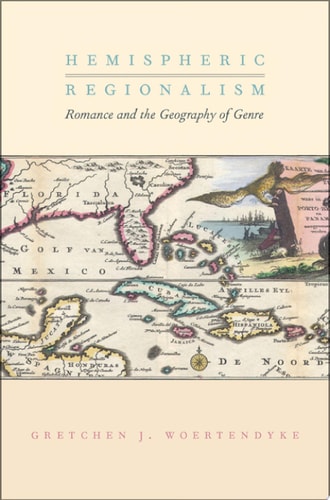
Hemispheric Regionalism: Romance and the Geography of Genre
0
0
As an Amazon Associate and affiliate partner, Menrva Books earns from qualifying purchases. Learn more
Author Description
In this broad ranging study, Gretchen Woertendyke reconfigures US literary history as a product of hemispheric relations. Hemispheric Regionalism: Romance and the Geography of Genre, brings together a rich archive of popular culture, fugitive slave narratives, advertisements, political treatises, and literature to construct a new literary history from a hemispheric and regional perspective. At the center of this history is romance, a popular and versatile literary genre uniquely capable of translating the threat posed by the Haitian Revolution--or the expansionist possibilities of Cuban annexation--for a rapidly increasing readership. Through romance, she traces imaginary and real circuits of exchange and remaps romance's position in nineteenth century life and letters as irreducible to, nor fully mediated by, a concept of nation. The energies associated with Cuba and Haiti, manifest destiny and apocalypse, bring historical depth to an otherwise short national history. As a result, romance becomes remarkably influential in inculcating a sense of new world citizenry. The study shifts our critical focus from novel and nation, to romance and region, inevitable, she argues, when we attend to the tangled, messy relations across geographic and historical boundaries.Woertendyke reads the archives of Gabriel Prosser, Nat Turner, and Denmark Vesey along with less frequently treated writers such as John Howison, William Gilmore Simms, and J.H. Ingraham. The study provides a new context for understanding works by Washington Irving, Edgar Allan Poe, Herman Melville, and James Fenimore Cooper and brings together the theories of Charles Brockden Brown, the editorial work of Maturin M. Ballou, and the historical romances of Walter Scott. In Hemispheric Regionalism, Woertendyke demonstrates that US literature has always been the product of hemispheric and regional relations and that all forms of romance are central to this history.
Menrva's Summary
THE THESIS
This study investigates how nineteenth-century US literary history was shaped by hemispheric relations rather than strictly national boundaries, specifically through the lens of the romance genre. Gretchen J. Woertendyke, an expert in American literature and hemispheric studies, utilizes a diverse archive of political treatises, fugitive slave narratives, and popular fiction to argue that the romance genre served as a primary vehicle for translating geopolitical anxieties and expansionist ambitions. By re-evaluating the role of romance, she posits that US identity was constructed through a complex, transnational exchange with regions like Cuba and Haiti.
THE SCOPE MAP
What You Will Find
- Analysis of nineteenth-century literary archives including fugitive slave narratives and political treatises
- Re-contextualization of canonical authors such as Edgar Allan Poe, Herman Melville, and Washington Irving
- Examination of the influence of the Haitian Revolution and Cuban annexation on US popular culture
Scope Limits
- The study does not provide a comprehensive history of the novel as a form
- It does not cover twentieth or twenty-first-century literary developments
THE AUTHORITY PERSPECTIVE
Scholars in the field of American studies recognize this work as a significant contribution to the shift toward hemispheric approaches in literary history. Readers frequently note the academic density of the prose and the breadth of the archival research presented by the author.
Page Count:
217
Publication Date:
2016-01-01
Publisher:
Oxford University Press
ISBN-10:
0190621281
ISBN-13:
9780190621285
History
English
Cultural Anthropology
Literary Criticism
Literary Form
Literature
American
English & College Success
Nineteenth century
Community Tags
Other Editions(2)
Similar Books




Reader Comments
Share Your Thoughts
No comments yet. Be the first to share your thoughts!