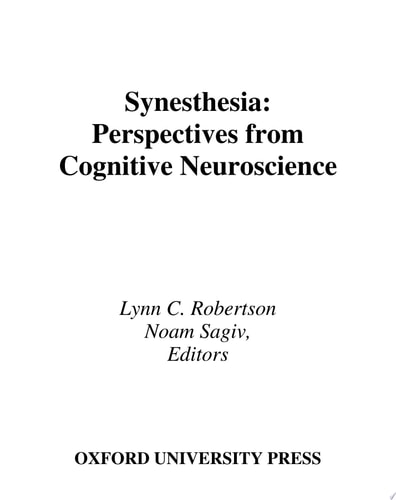
Synesthesia: Perspectives from Cognitive Neuroscience
0
0
As an Amazon Associate and affiliate partner, Menrva Books earns from qualifying purchases. Learn more
Author Description
Owing to its bizarre nature and its implications for understanding how brains work, synesthesia has recently received a lot of attention in the popular press and motivated a great deal of research and discussion among scientists. The questions generated by these two communities are intriguing: Does the synesthetic phenomenon require awareness and attention? How does a feature that is not present become bound to one that is? Does synesthesia develop or is it hard wired? Should it change our way of thinking about perceptual experience in general? What is its value in understanding perceptual systems as a whole?This volume brings together a distinguished group of investigators from diverse backgrounds--among them neuroscientists, novelists, and synesthetes themselves--who provide fascinating answers to these questions. Although each approaches synesthesia from a very different perspective, and each was curious about and investigated synesthesia for very different reasons, the similarities between their work cannot be ignored. The research presented in this volume demonstrates that it is no longer reasonable to ask whether or not synesthesia is real--we must now ask how we can account for it from cognitive, neurobiological, developmental, and evolutionary perspectives. This book will be important reading for any scientist interested in brain and mind, not to mention synesthetes themselves, and others who might be wondering what all the fuss is about.
Menrva's Summary
THE THESIS
This volume investigates the neurological and cognitive mechanisms underlying synesthesia to determine how this phenomenon informs our broader understanding of human perceptual systems. The authors, Lynn C. Robertson and Noam Sagiv, curate a collection of contributions from neuroscientists, researchers, and synesthetes to move beyond the question of the condition's validity. By synthesizing diverse data, the text argues that synesthesia serves as a critical model for studying brain function, developmental biology, and the evolution of sensory processing.
THE SCOPE MAP
What You Will Find
- Analysis of the role of awareness and attention in synesthetic experiences
- Examination of developmental versus hard-wired origins of sensory binding
- Integration of neurobiological, cognitive, and evolutionary research perspectives
- Case studies and personal accounts from synesthetes alongside empirical scientific data
THE AUTHORITY PERSPECTIVE
Experts recognize this volume as a foundational interdisciplinary resource for those studying sensory perception and brain architecture. Readers frequently note the academic density of the prose, which provides a rigorous examination of the subject suitable for researchers and students in the cognitive sciences.
Page Count:
304
Publication Date:
2004-10-14
Publisher:
Oxford University Press
ISBN-10:
019516623X
ISBN-13:
9780195166231
Psychology
Science
Non-Fiction
Synesthesia
Neuroscience
Community Tags
Similar Books