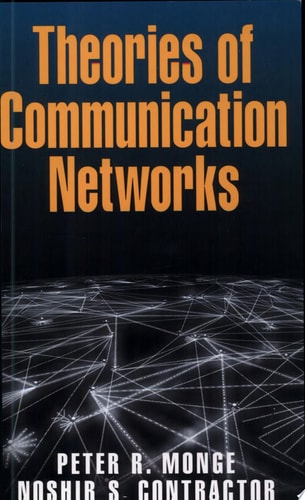
Theories of Communication Networks
0
0
As an Amazon Associate and affiliate partner, Menrva Books earns from qualifying purchases. Learn more
Author Description
To date, most network research contains one or more of five major problems. First, it tends to be atheoretical, ignoring the various social theories that contain network implications. Second, it explores single levels of analysis rather than the multiple levels out of which most networks are comprised. Third, network analysis has employed very little the insights from contemporary complex systems analysis and computer simulations. Foruth, it typically uses descriptive rather than inferential statistics, thus robbing it of the ability to make claims about the larger universe of networks. Finally, almost all the research is static and cross-sectional rather than dynamic.Theories of Communication Networks presents solutions to all five problems. The authors develop a multitheoretical model that relates different social science theories with different network properties. This model is multilevel, providing a network decomposition that applies the various social theories to all network levels: individuals, dyads, triples, groups, and the entire network. The book then establishes a model from the perspective of complex adaptive systems and demonstrates how to use Blanche, an agent-based network computer simulation environment, to generate and test network theories and hypotheses. It presents recent developments in network statistical analysis, the p* family, which provides a basis for valid multilevel statistical inferences regarding networks. Finally, it shows how to relate communication networks to other networks, thus providing the basis in conjunction with computer simulations to study the emergence of dynamic organizational networks.
Menrva's Summary
THE THESIS
This book investigates the methodological and theoretical limitations of contemporary network research by proposing a multitheoretical, multilevel framework for analyzing communication networks. Authors Noshir Contractor and Peter R. Monge, both established scholars in communication and organizational science, argue that existing research often fails to integrate social theory with dynamic, complex systems analysis. They present a robust model that bridges individual, dyadic, and group levels, utilizing advanced statistical tools and simulation environments to move beyond static, descriptive studies.
THE SCOPE MAP
What You Will Find
- A multitheoretical model linking social science theories to specific network properties.
- Methodologies for multilevel network decomposition across individuals, dyads, and groups.
- Application of complex adaptive systems theory and agent-based modeling using the Blanche simulation environment.
- Advanced statistical techniques, specifically the p* family, for making valid inferences in network research.
THE AUTHORITY PERSPECTIVE
Experts recognize this work as a foundational text for researchers seeking to integrate computational modeling with traditional social science theory. Readers frequently note the technical density of the prose, which is intended for advanced students and practitioners in the fields of communication and organizational behavior.
Page Count:
432
Publication Date:
2003-03-27
Publisher:
Oxford University Press
ISBN-10:
0195160371
ISBN-13:
9780195160376
Kindle Store
Complex Systems
Information Management
Organizational Theory
Communication
Kindle eBooks
Network Analysis
Categories
Social Science
Communications
Skills
Statistics
Community Tags
Similar Books