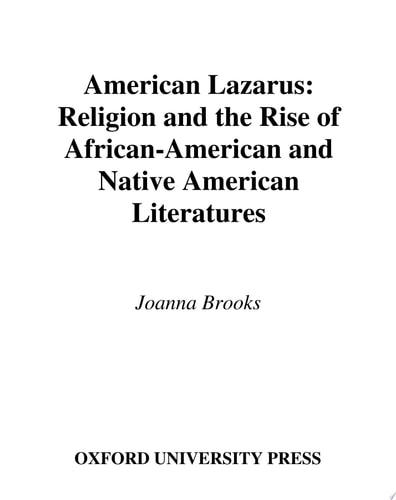
American Lazarus: Religion and the Rise of African-American and Native American Literatures
0
0
As an Amazon Associate and affiliate partner, Menrva Books earns from qualifying purchases. Learn more
Author Description
The 1780s and 1790s were a critical era for communities of color in the new United States of America. Even Thomas Jefferson observed that in the aftermath of the American Revolution, "the spirit of the master is abating, that of the slave rising from the dust." This book explores the means by which the very first Black and Indian authors rose up to transform their communities and the course of American literary history. It argues that the origins of modern African-American and American Indian literatures emerged at the revolutionary crossroads of religion and racial formation as early Black and Indian authors reinvented American evangelicalism and created new postslavery communities, new categories of racial identification, and new literary traditions.While shedding fresh light on the pioneering figures of African-American and Native American cultural history--including Samson Occom, Prince Hall, Richard Allen, Absalom Jones, and John Marrant--this work also explores a powerful set of little-known Black and Indian sermons, narratives, journals, and hymns. Chronicling the early American communities of color from the separatist Christian Indian settlement in upstate New York to the first African Lodge of Freemasons in Boston, it shows how eighteenth-century Black and Indian writers forever shaped the American experience of race and religion.American Lazarus offers a bold new vision of a foundational moment in American literature. It reveals the depth of early Black and Indian intellectual history and reassesses the political, literary, and cultural powers of religion in America.
Menrva's Summary
THE THESIS
This book investigates how early African-American and Native American authors utilized evangelical religion to forge new identities and literary traditions in the wake of the American Revolution. Joanna Brooks, a scholar of early American literature and religion, examines the intersection of racial formation and spiritual practice during the 1780s and 1790s. By analyzing sermons, journals, and hymns, she argues that these marginalized writers transformed American evangelicalism to create post-slavery and post-colonial communities. The work positions these early intellectual contributions as foundational to the development of modern American literature and cultural history.
THE SCOPE MAP
What You Will Find
- Analysis of primary texts including sermons, narratives, journals, and hymns from the late 18th century.
- Examination of key historical figures such as Samson Occom, Prince Hall, Richard Allen, Absalom Jones, and John Marrant.
- Exploration of specific geographic and cultural sites, including Christian Indian settlements in New York and the first African Lodge of Freemasons in Boston.
- A framework connecting the rise of racial identification to the evolution of American religious practices.
THE AUTHORITY PERSPECTIVE
Scholars and historians recognize this work as a significant contribution to the study of early American intellectual history and the development of minority literary traditions. Readers frequently note the academic rigor of the prose and the depth of the archival research presented throughout the text.
Page Count:
272
Publication Date:
2003-09-11
Publisher:
Oxford University Press
ISBN-10:
0195160789
ISBN-13:
9780195160789
Religion
History
Kindle eBooks
Literary Criticism
Categories
Christian literature
American
Kindle Store
Anthologies
Community Tags
Similar Books