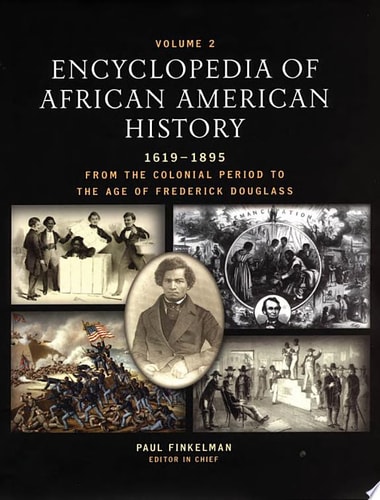
Encyclopedia of African American History, 1619-1895: From the Colonial Period to the Age of Frederick Douglass
0
0
As an Amazon Associate and affiliate partner, Menrva Books earns from qualifying purchases. Learn more
Author Description
It is impossible to understand America without understanding the history of African Americans. In nearly seven hundred entries, the Encyclopedia of African American History, 1619-1895 documents the full range of the African American experience during that period - from the arrival of the first slave ship to the death of Frederick Douglass - and shows how all aspects of American culture, history, and national identity have been profoundly influenced by the experience of African Americans.The Encyclopedia covers an extraordinary range of subjects. Major topics such as "Abolitionism," "Black Nationalism," the "Civil War," the "Dred Scott case," "Reconstruction," "Slave Rebellions and Insurrections," the "Underground Railroad," and "Voting Rights" are given the in-depth treatment one would expect. But the encyclopedia also contains hundreds of fascinating entries on less obvious subjects, such as the "African Grove Theatre," "Black Seafarers," "Buffalo Soldiers," the "Catholic Church and African Americans," "Cemeteries and Burials," "Gender," "Midwifery," "New York African Free Schools," "Oratory and Verbal Arts," "Religion and Slavery," the "Secret Six," and much more. In addition, the Encyclopedia offers brief biographies of important African Americans - as well as white Americans who have played a significant role in African American history - from Crispus Attucks, John Brown, and Henry Ward Beecher to Olaudah Equiano, Frederick Douglass, Sarah Grimké, Sojourner Truth, Nat Turner, Phillis Wheatley, and many others.All of the Encyclopedia's alphabetically arranged entries are accessibly written and free of jargon and technical terms. To facilitate ease of use, many composite entries gather similar topics under one headword. The entry for Slave Narratives, for example, includes three subentries: The Slave Narrative in America from the Colonial Period to the Civil War, Interpreting Slave Narratives, and African and British Slave Narratives. A headnote detailing the vari
Menrva's Summary
THE THESIS
This encyclopedia investigates the foundational role of African American history in shaping the broader American national identity from 1619 to 1895. Paul Finkelman, a distinguished scholar in legal and constitutional history, compiles nearly seven hundred entries to document the trajectory of the African American experience. By synthesizing primary historical data and biographical accounts, the work argues that American culture and history cannot be fully understood without centering the contributions and struggles of African Americans during this transformative era.
THE SCOPE MAP
What You Will Find
- Comprehensive coverage of major historical milestones including the Civil War, Reconstruction, and the abolitionist movement.
- Biographical profiles of significant figures ranging from Frederick Douglass and Sojourner Truth to key white historical actors.
- Detailed thematic entries on cultural and social phenomena such as the African Grove Theatre, oral traditions, and religious practices.
- A structured, alphabetically arranged reference framework designed for accessibility and ease of cross-referencing.
THE AUTHORITY PERSPECTIVE
Experts and researchers frequently cite this work as a foundational reference for students and scholars seeking a comprehensive overview of the period. Readers note the clarity of the prose, which avoids excessive academic jargon while maintaining rigorous historical accuracy.
Page Count:
1560
Publication Date:
2006-04-06
Publisher:
Oxford University Press
ISBN-10:
0195167775
ISBN-13:
9780195167771
History
Biography
African Americans
United States
Social Science
Reference
Community Tags
Similar Books


Reader Comments
Share Your Thoughts
No comments yet. Be the first to share your thoughts!