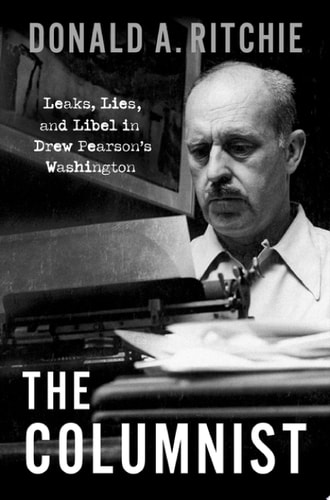
The Columnist: Leaks, Lies, and Libel in Drew Pearson's Washington
0
0
As an Amazon Associate and affiliate partner, Menrva Books earns from qualifying purchases. Learn more
Author Description
Long before Wikileaks and social media, the journalist Drew Pearson exposed to public view information that public officials tried to keep hidden. A self-professed "keyhole peeper", Pearson devoted himself to revealing what politicians were doing behind closed doors. From 1932 to 1969, his daily "Washington Merry-Go-Round" column and weekly radio and TV commentary broke secrets, revealed classified information, and passed along rumors based on sources high and low in the federal government, while intelligence agents searched fruitlessly for his sources.For forty years, this syndicated columnist and radio and television commentator called public officials to account and forced them to confront the facts. Pearson's daily column, published in more than 600 newspapers, and his weekly radio and television commentaries led to the censure of two US senators, sent four members of the House to prison, and undermined numerous political careers. Every president from Franklin Roosevelt to Richard Nixon--and a quorum of Congress--called him a liar. Pearson was sued for libel more than any other journalist, in the end winning all but one of the cases.Breaking secrets was the heartbeat of Pearson's column. His ability to reveal classified information, even during wartime, motivated foreign and domestic intelligence agents to pursue him. He played cat and mouse with the investigators who shadowed him, tapped his phone, read his mail, and planted agents among his friends. Yet they rarely learned his sources. The FBI found it so fruitless to track down leaks to the columnist that it advised agencies to simply do a better job of keeping their files secret. Drawing on Pearson's extensive correspondence, diaries, and oral histories, The Columnist reveals the mystery behind Pearson's leaks and the accuracy of his most controversial revelations.
Menrva's Summary
THE THESIS
This biography investigates how Drew Pearson, a prominent 20th-century journalist, utilized a vast network of clandestine sources to expose government secrets and influence American political discourse. Donald A. Ritchie, a historian and expert on the U.S. Senate, utilizes Pearson's personal diaries, extensive correspondence, and government records to construct a detailed account of the columnist's career. The book argues that Pearson functioned as a critical, albeit controversial, check on federal power by forcing transparency through the public dissemination of classified information.
THE SCOPE MAP
What You Will Find
- A comprehensive history of the "Washington Merry-Go-Round" column from 1932 to 1969.
- Analysis of the legal battles, including numerous libel suits, faced by Pearson throughout his career.
- Documentation of the cat-and-mouse dynamic between Pearson and federal intelligence agencies like the FBI.
Scope Limits
- The text focuses primarily on Pearson's professional activities rather than his private domestic life.
- It does not provide an exhaustive analysis of every single column written over his four-decade career.
THE AUTHORITY PERSPECTIVE
Historians and political scholars recognize this work as a definitive account of mid-century American journalism and the evolution of political leaks. Readers frequently note the meticulous archival research that provides a clear window into the tension between the press and the federal government during the mid-20th century.
Page Count:
384
Publication Date:
2021-06-01
Publisher:
Oxford University Press
ISBN-10:
0190067586
ISBN-13:
9780190067588
Politics
Biography
History
New Used & Rental Textbooks
Writing Guides
Writing
United States
Leaders & Notable People
General
Corruption & Misconduct
Reference
Political
Journalists
Mass Communication
Journalism
Media Studies
Social History
English literature
Social Science
Politics & Government
Specific Topics
Community Tags
Other Editions(2)

Similar Books










Reader Comments
Share Your Thoughts
No comments yet. Be the first to share your thoughts!