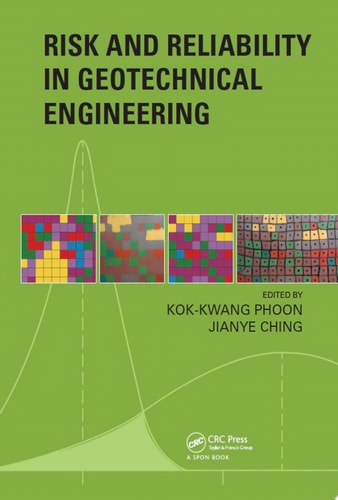
Risk and Reliability in Geotechnical Engineering
0
0
As an Amazon Associate and affiliate partner, Menrva Books earns from qualifying purchases. Learn more
Author Description
Establishes Geotechnical Reliability as Fundamentally Distinct from Structural Reliability Reliability-based design is relatively well established in structural design. Its use is less mature in geotechnical design, but there is a steady progression towards reliability-based design as seen in the inclusion of a new Annex D on "Reliability of Geotechnical Structures" in the third edition of ISO 2394. Reliability-based design can be viewed as a simplified form of risk-based design where different consequences of failure are implicitly covered by the adoption of different target reliability indices. Explicit risk management methodologies are required for large geotechnical systems where soil and loading conditions are too varied to be conveniently slotted into a few reliability classes (typically three) and an associated simple discrete tier of target reliability indices. Provides Realistic Practical Guidance Risk and Reliability in Geotechnical Engineering makes these reliability and risk methodologies more accessible to practitioners and researchers by presenting soil statistics which are necessary inputs, by explaining how calculations can be carried out using simple tools, and by presenting illustrative or actual examples showcasing the benefits and limitations of these methodologies. With contributions from a broad international group of authors, this text: Presents probabilistic models suited for soil parameters Provides easy-to-use Excel-based methods for reliability analysis Connects reliability analysis to design codes (including LRFD and Eurocode 7) Maximizes value of information using Bayesian updating Contains efficient reliability analysis methods Accessible To a Wide Audience Risk and Reliability in Geotechnical Engineering presents all the "need-to-know" information for a non-specialist to calculate and interpret the reliability index and risk of geotechnical structures in a realistic and robust way. It suits engineers, researchers, and students who are
Menrva's Summary
THE THESIS
This book establishes geotechnical reliability as fundamentally distinct from structural reliability and provides practical guidance for risk-based design in geotechnical engineering. It addresses the relative immaturity of reliability-based design in geotechnical contexts compared to structural engineering, noting the progression seen in standards like ISO 2394. The text argues that explicit risk management is necessary for complex geotechnical systems where simple reliability classes are insufficient. It aims to make these methodologies accessible to practitioners and researchers by providing essential soil statistics, explaining calculations with simple tools, and showcasing real-world examples.
THE SCOPE MAP
- Probabilistic models specifically suited for soil parameters.
- Easy-to-use Excel-based methods for performing reliability analysis.
- Connections between reliability analysis and current design codes, including LRFD and Eurocode 7.
- Methods for maximizing the value of information through Bayesian updating.
- Efficient techniques for reliability analysis.
- Illustrative and actual examples demonstrating the benefits and limitations of reliability methodologies.
THE AUTHORITY PERSPECTIVE
The book is presented as a valuable resource for engineers, researchers, and students seeking to understand and apply reliability and risk methodologies in geotechnical engineering. Its approach aims to make complex calculations and interpretations accessible, even for non-specialists. The inclusion of practical tools like Excel-based methods and connections to design codes suggests a focus on bridging theoretical concepts with real-world application. The contributions from an international group of authors indicate a broad perspective on the subject matter.
Page Count:
624
Publication Date:
2018-10-09
Publisher:
Taylor & Francis
ISBN-10:
1482227223
ISBN-13:
9781482227222
Non-Fiction
Science & Technology
Soil Mechanics
Geotechnical Engineering
Community Tags
Other Editions(2)
Similar Books
Reader Comments
Share Your Thoughts
No comments yet. Be the first to share your thoughts!