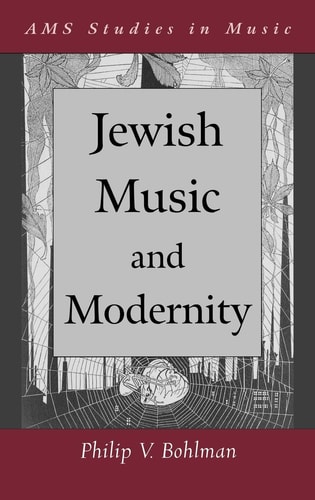
Jewish Music and Modernity
0
0
As an Amazon Associate and affiliate partner, Menrva Books earns from qualifying purchases. Learn more
Author Description
Is there really such a thing as Jewish music? And how does it survive as a practice of worship and cultural expression even in the face of the many brutal aesthetic and political challenges of modernity? In Jewish Music and Modernity, Philip V. Bohlman imparts these questions with a new light that transforms the very historiography of Jewish culture in modernity.Based on decades of fieldwork and archival study throughout the world, Bohlman intensively examines the many ways in which music has historically borne witness to the confrontation between modern Jews and the world around them. Weaving a historical narrative that spans from the end of the Middle Ages to the Holocaust, he moves through the vast confluence of musical styles and repertories. From the sacred and to the secular, from folk to popular music, and in the many languages in which it was written and performed, he accounts for areas of Jewish music that have rarely been considered before. Jewish music, argues Bohlman, both survived in isolation and transformed the nations in which it lived. When Jews and Jewish musicians entered modernity, authenticity became an ideal to be supplanted by the reality of complex traditions. Klezmer music emerged in rural communities cohabited by Jews and Roma; Jewish cabaret resulted from the collaborations of migrant Jews and non-Jews to the nineteenth-century metropoles of Berlin and Budapest, Prague and Vienna; cantors and composers experimented with new sounds. The modernist impulse from Felix Mendelssohn to Gustav Pick to Arnold Schoenberg and beyond became possible because of the ways music juxtaposed aesthetic and cultural differences.Jewish Music and Modernity demonstrates how borders between repertories are crossed and the sound of modernity is enriched by the movement of music and musicians from the peripheries to the center of modern culture. Bohlman ultimately challenges readers to experience the modern confrontation of self and other anew.
Menrva's Summary
THE THESIS
This work investigates the fundamental question of whether a distinct category of Jewish music exists and how it has functioned as a vehicle for cultural and religious survival amidst the aesthetic and political pressures of the modern era. Philip V. Bohlman, a distinguished ethnomusicologist, utilizes decades of global fieldwork and archival research to construct a comprehensive historiography of Jewish musical expression. He argues that Jewish music is not a static tradition but a dynamic, evolving practice that has both maintained its internal integrity and significantly influenced the broader cultural landscapes of the nations in which Jewish communities resided.
THE SCOPE MAP
What You Will Find
- A historical analysis spanning from the late Middle Ages through the Holocaust.
- Examination of diverse musical genres including sacred liturgy, folk traditions, klezmer, and cabaret.
- Case studies of musical cross-pollination in urban centers like Berlin, Budapest, Prague, and Vienna.
- Theoretical frameworks regarding the intersection of Jewish identity, modernity, and aesthetic authenticity.
THE AUTHORITY PERSPECTIVE
Scholars and musicologists recognize this text as a significant contribution to the field of ethnomusicology for its expansive scope and rigorous archival methodology. Readers frequently note the academic density of the prose, which serves as a foundational resource for those studying the intersection of cultural identity and musical history.
Page Count:
320
Publication Date:
2008-11-26
Publisher:
Oxford University Press
ISBN-10:
0195178327
ISBN-13:
9780195178326
History
Music
Jews
Jewish Studies
Jews germany
Musicology
Criticism history
Jews music
Modernism Art
Community Tags
Other Editions(3)

Similar Books





Reader Comments
Share Your Thoughts
No comments yet. Be the first to share your thoughts!