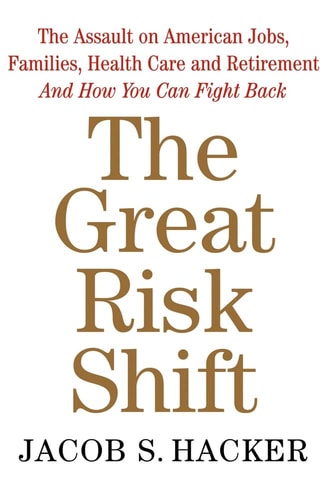
The Great Risk Shift: The Assault on American Jobs, Families, Health Care, and Retirement--And How You Can Fight Back
0
0
As an Amazon Associate and affiliate partner, Menrva Books earns from qualifying purchases. Learn more
Author Description
America's leaders say the economy is strong and getting stronger. But ordinary Americans aren't buying it. They see what the rosy statistics hide: We are all struggling under the weight of terrifying economic instability. No matter how well educated and hard working we are, we know that the bottom can fall out at any moment. Meanwhile, the safety net that once protected us is fast unraveling. With retirement plans in growing jeopardy while health coverage erodes, more and more economic risk is shifting from government and business onto the fragile shoulders of the American family.The book documents how two great pillars of economic security--the family and the workplace--guarantee far less financial stability than they once did. The final leg of economic support--the public and private benefits that workers and families get when economic disaster strikes--has dangerously eroded as political leaders and corporations increasingly cut back protections of our health care, our income security, and our retirement pensions. Hacker concludes by advocating an "insurance and opportunity society" that would safeguard economic security and expand economic opportunity, ensuring that all Americans have the basic financial security they need to reach for and achieve the American Dream.
Menrva's Summary
THE THESIS
This book investigates the systemic transfer of economic risk from institutions to individual households and the resulting erosion of the American middle-class safety net. Jacob S. Hacker, a professor of political science, utilizes extensive economic data and historical policy analysis to argue that the traditional pillars of security—the workplace and the family—have been undermined by corporate and political shifts. He posits that this instability is not an accidental byproduct of the modern economy but a deliberate consequence of policy decisions that prioritize deregulation and cost-shifting over collective protection.
THE SCOPE MAP
What You Will Find
- Analysis of the decline in employer-provided health insurance and defined-benefit pension plans.
- Examination of the historical transition from institutional stability to individual market volatility.
- Use of longitudinal economic data and public policy case studies to track shifting financial burdens.
- A proposed framework for an 'insurance and opportunity society' designed to restore basic economic security.
THE AUTHORITY PERSPECTIVE
Experts frequently cite this work as a foundational text for understanding the structural causes of economic anxiety in the early 21st century. Readers often note the academic rigor of the prose, which balances complex policy arguments with clear implications for the average American household.
Page Count:
256
Publication Date:
2006-10-09
Publisher:
Oxford University Press
ISBN-10:
0195179501
ISBN-13:
9780195179507
Economics
Public Policy
United States
Sociology
Finance
Labor
Community Tags
Similar Books