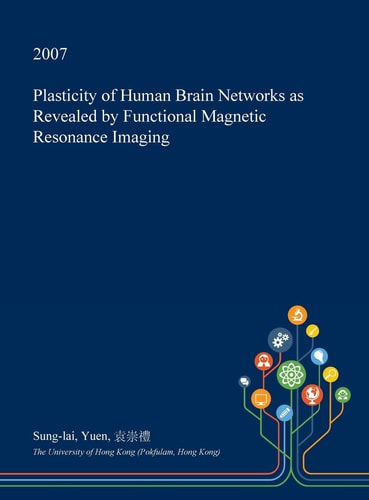
Plasticity of Human Brain Networks As Revealed by Functional Magnetic Resonance Imaging
0
0
As an Amazon Associate and affiliate partner, Menrva Books earns from qualifying purchases. Learn more
Author Description
This dissertation, "Plasticity of Human Brain Networks as Revealed by Functional Magnetic Resonance Imaging" by Sung-lai, Yuen,, was obtained from The University of Hong Kong (Pokfulam, Hong Kong) and is being sold pursuant to Creative Commons: Attribution 3.0 Hong Kong License. The content of this dissertation has not been altered in any way. We have altered the formatting in order to facilitate the ease of printing and reading of the dissertation. All rights not granted by the above license are retained by the author. Abstract: Abstract of thesis entitled Plasticity of human brain networks as revealed by functional magnetic resonance imaging Submitted by YUEN Sung Lai For the degree of Doctor of Philosophy at the University of Hong Kong in May 2007 The whole concept of "neural plasticity" has attracted a lot of research attention for its potential benefit to many people living with the sequalae of various brain pathologies. Via environmental influences and internal neurochemical activities, our brain exercises its potential of organizing itself in such a way that functions could be maximized. This thesis reports a series of neuroimaging studies that examines three forms of neural plasticity, namely 1) training-induced plasticity; 2) plastic change of brain circuitry after congenital or early sensory deficit; and 3) reorganization of neural circuitry after recovery from brain injury. In study one, we trained a group of healthy volunteers on a novel task that associates auditory signals with spatial information. Results showed that continuous training reduced activities in the general executive circuit supporting general task performance but increased activities in task-specific sensory processing regions. The coupling between general executive circuit and task-specific sensory regions may form the basis of training-induced connectivity. 1In study two, we recruited a group of blind subjects who were deprived of visual inp
Menrva's Summary
THE THESIS
This dissertation investigates the plasticity of human brain networks using functional magnetic resonance imaging (fMRI) to explore how the brain reorganizes itself in response to various stimuli and conditions. The author examines three key forms of neural plasticity: training-induced changes, alterations following congenital or early sensory deficits, and reorganization after brain injury. The research utilizes fMRI to map these changes, focusing on the functional connectivity between different brain circuits. The findings suggest that continuous training can lead to a shift in brain activity from general executive circuits to more task-specific sensory regions, potentially forming the basis of enhanced connectivity.
THE SCOPE MAP
- Examination of training-induced neural plasticity in healthy volunteers through novel auditory-spatial association tasks.
- Analysis of plastic changes in brain circuitry following congenital or early sensory deprivation, specifically in blind subjects.
- Investigation into the reorganization of neural circuitry after recovery from brain injury.
- Use of functional Magnetic Resonance Imaging (fMRI) as the primary neuroimaging technique.
- Discussion on the potential benefits of neural plasticity for individuals with brain pathologies.
- Exploration of environmental influences and internal neurochemical activities on brain organization.
- Findings on the coupling between general executive circuits and task-specific sensory regions.
THE AUTHORITY PERSPECTIVE
This work presents a detailed examination of neural plasticity through advanced neuroimaging techniques. The research focuses on empirical studies investigating how the brain adapts to training, sensory deficits, and injury. The methodology, centered on fMRI, provides a quantitative approach to understanding functional connectivity changes. The findings contribute to the broader understanding of the brain's capacity for self-organization and recovery.
Page Count:
124
Publication Date:
2017-01-27
Publisher:
BiblioBazaar
ISBN-10:
1374669156
ISBN-13:
9781374669154
Non-Fiction
Psychology
Science
Research
Neuroscience
Community Tags
Similar Books










Reader Comments
Share Your Thoughts
No comments yet. Be the first to share your thoughts!