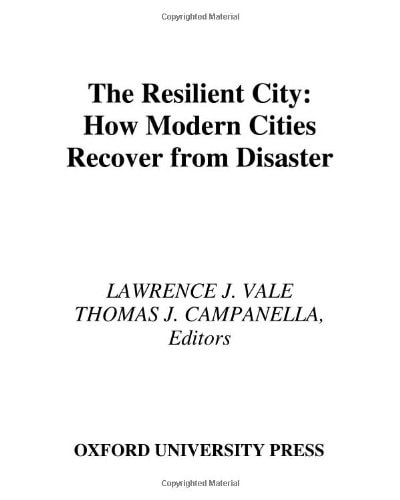
The Resilient City: How Modern Cities Recover from Disaster
0
0
As an Amazon Associate and affiliate partner, Menrva Books earns from qualifying purchases. Learn more
Author Description
For as long as they have existed, cities have been destroyed--sacked, shaken, burnt, bombed, flooded, starved, irradiated, and pillaged--in almost every case they have risen again. Rarely in modern times has a city not been rebuilt following destruction, be it natural or man-made. The Resilient City explores urban disasters from around the globe and the ongoing restoration of urban life. It examines why cities are rebuilt, how a vision for the future gets incorporated into a new urban landscape, and how disasters have been interpreted and commemorated in built form. An international cast of historians, architects, and urban studies experts looks at a diverse group of cities that have suffered traumas, including: * the Oklahoma City bombing * Chicago's great fire of 1871 * San Francisco's earthquake and fires of 1906 * Washington's invasion by the British during the War of 1812 * Berlin and Warsaw in World War II * Gernika's bombardment during the Spanish Civil War * Jerusalem's rebuilding following centuries of destruction * Mexico City's 1985 earthquake * China's Tangshan earthquake * Tokyo's earthquake, fires, and WWII bombardment * Beirut in the 1990s wars * South Central Los Angeles following the Rodney King beating In so doing, they bring to light the experiences these resilient cities share, while underscoring that no two cities have recovered in the precisely the same way. This book will appeal to anyone interested in cities, among humankind's most durable artifacts and enduring forms of communal life.
Menrva's Summary
THE THESIS
This book investigates the persistent phenomenon of urban recovery, asking why and how cities consistently rebuild following catastrophic natural or man-made destruction. Lawrence J. Vale and Thomas J. Campanella, both distinguished scholars in urban studies and planning, curate a collection of essays from an international group of historians and architects. They argue that while the impulse to rebuild is universal, the specific methods and commemorative forms adopted by each city reflect unique political, social, and cultural contexts. The text provides a comparative framework for understanding the resilience of urban environments as durable artifacts of communal life.
THE SCOPE MAP
What You Will Find
- Comparative analysis of urban disasters including the 1871 Chicago fire, the 1906 San Francisco earthquake, and the post-WWII reconstruction of Berlin and Warsaw.
- Examination of the role of urban planning and architectural vision in shaping the post-disaster landscape.
- Analysis of how cities use built forms and monuments to interpret and commemorate traumatic events.
- Case studies covering a wide range of global contexts, from the Oklahoma City bombing to the rebuilding of Beirut and Jerusalem.
THE AUTHORITY PERSPECTIVE
Experts and urban planners frequently cite this work as a foundational text for understanding the intersection of disaster recovery and urban design. Readers often note the academic rigor of the case studies, which provide a comprehensive look at the complexities involved in restoring urban life after trauma.
Page Count:
392
Publication Date:
2005-01-01
Publisher:
Oxford University Press
ISBN-10:
0195175840
ISBN-13:
9780195175844
Architecture
History
Urban renewal
urban planning
Sociology
Disasters
Community Tags
Similar Books