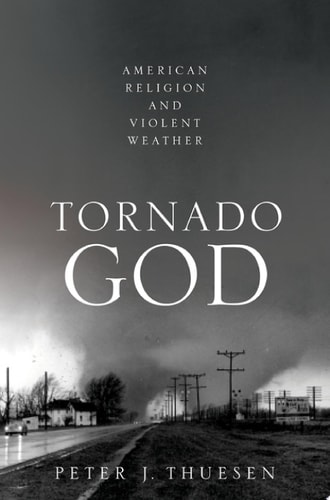
Tornado God: American Religion and Violent Weather
0
0
As an Amazon Associate and affiliate partner, Menrva Books earns from qualifying purchases. Learn more
Author Description
One of the earliest sources of humanity's religious impulse was severe weather, which ancient peoples attributed to the wrath of storm gods. Enlightenment thinkers derided such beliefs as superstition and predicted they would pass away as humans became more scientifically and theologically sophisticated. But in America, scientific and theological hubris came face-to-face with the tornado, nature's most violent windstorm. Striking the United States more than any other nation, tornadoes have consistently defied scientists' efforts to unlock their secrets. Meteorologists now acknowledge that even the most powerful computers will likely never be able to predict a tornado's precise path.Similarly, tornadoes have repeatedly brought Americans to the outer limits of theology, drawing them into the vortex of such mysteries as how to reconcile suffering with a loving God and whether there is underlying purpose or randomness in the universe. In this groundbreaking history, Peter Thuesen captures the harrowing drama of tornadoes, as clergy, theologians, meteorologists, and ordinary citizens struggle to make sense of these death-dealing tempests. He argues that, in the tornado, Americans experience something that is at once culturally peculiar (the indigenous storm of the national imagination) and religiously primal (the sense of awe before an unpredictable and mysterious power). He also shows that, in an era of climate change, the weather raises the issue of society's complicity in natural disasters. In the whirlwind, Americans confront the question of their own destiny-how much is self-determined and how much is beyond human understanding or control.
Menrva's Summary
THE THESIS
This book investigates how the persistent threat of tornadoes in the United States has shaped American theological discourse and the cultural perception of divine power versus scientific understanding. Peter J. Thuesen, a professor of religious studies, utilizes historical records, theological texts, and meteorological accounts to argue that the tornado functions as a unique intersection of American religious identity and the limits of human control. He examines how these storms force a confrontation between the desire for scientific predictability and the enduring human impulse to find meaning in natural catastrophe.
THE SCOPE MAP
What You Will Find
- Historical analysis of American responses to severe weather from the colonial era to the present.
- Examination of the intersection between meteorology and theology.
- Discussion of climate change as a modern catalyst for debates on human complicity in natural disasters.
Scope Limits
- The text does not provide a comprehensive technical manual for tornado forecasting or meteorological science.
- It does not offer a global comparative study of storm-related religions outside the American context.
THE AUTHORITY PERSPECTIVE
Scholars and reviewers note the text's ability to bridge the gap between scientific history and religious studies with academic rigor. Experts highlight this as a significant contribution to understanding how environmental phenomena influence national identity and theological development.
Page Count:
307
Publication Date:
2020-01-01
Publisher:
Oxford University Press
ISBN-10:
019068030X
ISBN-13:
9780190680305
History
Religion
Meteorology
Tornadoes
Sociology
Philosophy of
History of the Americas
American Studies
Disasters
Cultural Anthropology
Community Tags
Similar Books