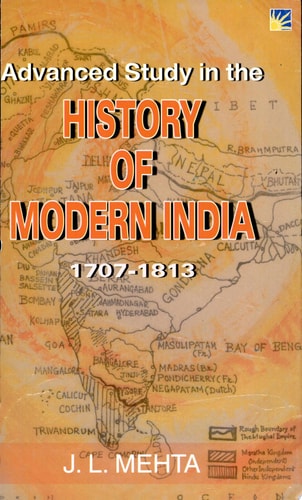
Advanced Study in the History of Modern India 1707-1813
0
0
As an Amazon Associate and affiliate partner, Menrva Books earns from qualifying purchases. Learn more
Author Description
In the present volume, the author gives an analytical and critical account of the political history of early modern India from A D 1707 to 1813. The study begins with the death of Aurangzeb, the last imperial ruler of the Mughal Dynasty, and carries the story of political and military developments through the eighteenth century, which comprises `an epoch of transition' from the medieval to the modern period of Indian history. The narrative shatters the contention of contemporary European writers that it was `the dark age' of Indian history, characterized by `political anarchy and misgovernment', until the British brought it under their sway. The main thesis of the author is that the political developments of the period were marked by two distinct phases; the first phase, which lasted from 1707 to 1760, saw the rapid disintegration of the Mughal power and its replacement by the Maratha hegemony. Delhi became the hub of Maratha activities from 1752 and fell under their complete control by 1760. The Afghan invader, Ahmad Shah Abdali, gave a serious blow to the Maratha power in the third battle of Panipat (1761), albeit, their Afghan and Mughal adversaries were also ruined within a decade. On the other hand, the Marathas effected phenomenal revival of their power under their fourth Peshwa Madhav Rao (1761-72). Meanwhile, the English traders turned colonialists, after consolidating their hold along the Indian seacoasts and conquest of `Carnatic' and Bengal, challenged the Maratha hegemony. The second phase of developments was thus marked by the struggle for supremacy between these two powers almost exclusively. Nevertheless, for full 31 years after 1772, the Marathas were in absolute control of Delhi, and wielded imperial powers as de facto as well as de jure rulers of the country in the name of the phantom Mughal emperor until they were dislodged from there in 1803. The Marathas were defeated but not yet out by the year 1813. The author makes a judicious use of the cont
Menrva's Summary
THE THESIS
This study provides an analytical and critical account of the political history of early modern India from 1707 to 1813, challenging the notion of this period as a 'dark age'. The author examines the transition from the Mughal Empire to British rule, detailing the rise and fall of various powers and the shifting political landscape. The narrative focuses on the disintegration of Mughal power, the ascendance of the Marathas, and the eventual struggle for supremacy between the Marathas and the English East India Company.
THE SCOPE MAP
- The political and military developments from the death of Aurangzeb (1707) to 1813.
- An analysis of the two distinct phases of political change: 1707-1760 (Mughal disintegration and Maratha hegemony) and 1761-1813 (Maratha revival and Anglo-Maratha conflict).
- Detailed examination of key events such as the Third Battle of Panipat (1761) and the Marathas' control of Delhi.
- Discussion of the English East India Company's transition from traders to colonial rulers.
- Critique of contemporary European accounts that characterized the period as anarchic.
- The author's main thesis regarding the progressive political developments and power shifts during the 18th century.
THE AUTHORITY PERSPECTIVE
This work is recognized for its detailed and critical examination of a pivotal period in Indian history. It challenges prevailing narratives by presenting a nuanced view of the 18th century, highlighting the agency and political maneuvering of Indian powers like the Marathas. The author's analysis of the transition from Mughal decline to the rise of British influence offers a comprehensive perspective for scholars and students of Indian history. The book is valued for its judicious use of sources and its clear articulation of the period's complex political dynamics.
Page Count:
739
Publication Date:
2005-01-01
Publisher:
Sterling Publishers Pvt. Ltd
ISBN-10:
1932705546
ISBN-13:
9781932705546
Non-Fiction
History
Modern History
Indian History
Community Tags
Similar Books