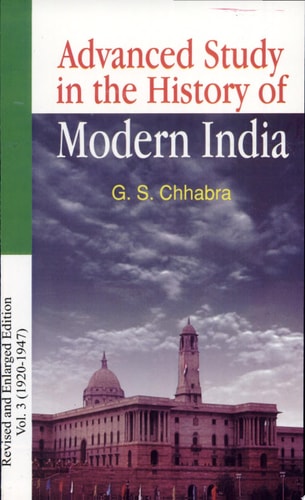
Advanced Study in the History of Modern India: 1920-1947
0
0
As an Amazon Associate and affiliate partner, Menrva Books earns from qualifying purchases. Learn more
Author Description
Product Description Third volume of Advanced Study in the History of Modern India starts with the first Non-cooperation Movement of Gandhi, wades through his Mass Civil Disobedience, Individual Civil Disobedience, the Quit India Movement, partition of th country and his unfortunate ultimate removal from the scene through the hands of an assassin. At the same time in the constitutional development it passes through the labour pains and birth of the Government of India Act 1935, the Indian Independence Act 1947, and the ultimate British departure from the country. The author discusses the Second World War and how it impacted the Indian politics, the rise of the demand for Pakistan and its ultimate realization. An interesting section of the book deals with important personalities of the time,their beliefs and their activities. All through the language used is simple and expression is lucid. His views on Gandhi, the Father of the Indian Nation, deserve a spacial attention. About the Author G. S. Chhabra, b. 1928, obtained his Masters (1951) and Ph.D. (1955) degrees from the University of Punjab and joined Khalsa College, Jalandhar as lecture in 1954. He shifted to Ramgarhia College, Phagwara as head of the post-graduate department of history (1956-63) and then to the University of Jammu where he was dean faculty of social sciences and professor and head of the department of history retiring in 1988. He has been a visiting professor in U.S.A. And presently divides his time between that country and India.
Menrva's Summary
THE THESIS
The book investigates the pivotal period of India's struggle for independence and its immediate aftermath, from the rise of Gandhian movements to the nation's partition and the establishment of its new political order. The author, G.S. Chhabra, a distinguished historian with extensive academic experience, draws upon his expertise to analyze the complex political and constitutional developments of this era. The narrative covers key events such as the Non-Cooperation Movement, Civil Disobedience, the Quit India Movement, and the impact of World War II on Indian politics, culminating in the partition and British departure. It also examines the rise of the demand for Pakistan and offers insights into the prominent personalities and their contributions during this transformative period.
THE SCOPE MAP
- The Non-Cooperation Movement and Gandhi's mass civil disobedience campaigns.
- The Individual Civil Disobedience movement and the Quit India Movement.
- The constitutional developments leading to the Government of India Act 1935 and the Indian Independence Act 1947.
- The impact of the Second World War on Indian politics.
- The rise of the demand for Pakistan and its eventual realization.
- An examination of important personalities of the era, their beliefs, and activities.
- Analysis of Gandhi's role and views, with special attention to his significance as the Father of the Indian Nation.
THE AUTHORITY PERSPECTIVE
The book is presented as a comprehensive study of modern Indian history, focusing on the critical years between 1920 and 1947. The author's academic background and extensive experience in history departments suggest a scholarly approach to the subject matter. The description highlights the book's lucid expression and simple language, aiming to make complex historical events accessible to readers. The inclusion of detailed analysis of key movements, constitutional acts, and influential personalities indicates a thorough exploration of the period.
Page Count:
268
Publication Date:
2005-01-01
Publisher:
Lotus Press
ISBN-10:
8189093088
ISBN-13:
9788189093082
History
Politics
Non-Fiction
Indian History
Modern History
Community Tags
Similar Books