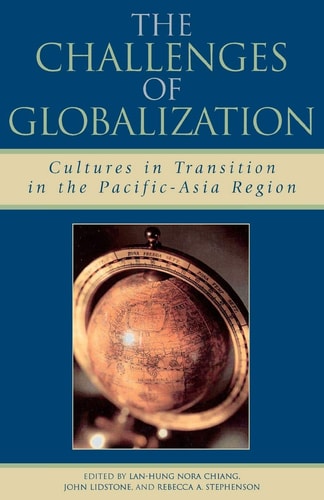
The Challenges of Globalization: Cultures in Transition in the Pacific-Asia Region
0
0
As an Amazon Associate and affiliate partner, Menrva Books earns from qualifying purchases. Learn more
Author Description
Although the products of globalization are far from new, globalization as a process in the Pacific-Asian Region is both dynamic and problematic. Pacific-Asia globalization outcomes at present include: intensification of changes linked to the influences of capitalism; information technology and innovative technological systems; migration, transnationalism, and refugees; tourism for those with newly apparent disposable incomes; altered philosophical and religious perspectives, including the new fundamentalism; paradigm shifts within indigenous languages and cultures; lifestyles that embrace and/or disengage from all of the globalizing factors listed above; and others. The Challenges of Globalization defines globalization as "supra-national ideas and processes that cross national borders with impunity." Such "ideas and processes" may appear to possess a will of their own, fostering closer links between cultures, societies, and economies. But, do they? How do individuals, communities, and nation-states actually respond to the forces of globalization? This book explores globalization within the natural sciences, social sciences, humanities, and education.
Menrva's Summary
THE THESIS
This book investigates the complex and often contradictory outcomes of globalization within the Pacific-Asian region. It examines how the intensification of capitalism, advancements in information technology, increased migration, and the rise of tourism have reshaped societies, economies, and cultures. The authors explore the resulting shifts in philosophical and religious perspectives, the impact on indigenous languages and lifestyles, and the varied individual and collective responses to these supra-national forces.
THE SCOPE MAP
- Analysis of the influences of capitalism on the Pacific-Asian region.
- Examination of information technology and innovative systems.
- Discussion of migration, transnationalism, and refugee issues.
- Exploration of tourism's impact on newly apparent disposable incomes.
- Investigation of altered philosophical and religious perspectives, including new fundamentalism.
- Assessment of paradigm shifts within indigenous languages and cultures.
- Study of lifestyles that embrace or disengage from globalizing factors.
THE AUTHORITY PERSPECTIVE
The book is presented as an exploration of the dynamic and problematic nature of globalization in the Pacific-Asian region. It aims to define globalization and question how individuals, communities, and nation-states respond to its forces. The work spans multiple disciplines, including natural sciences, social sciences, humanities, and education, suggesting a broad and interdisciplinary approach to understanding these complex changes. The authors' definition of globalization as 'supra-national ideas and processes that cross national borders with impunity' frames the subsequent analysis of its multifaceted impacts.
Page Count:
180
Publication Date:
2004-10-05
Publisher:
Bloomsbury Academic
ISBN-10:
0761829512
ISBN-13:
9780761829515
Non-Fiction
Philosophy
Economics
Religion
Technology
Education
Sociology
Globalization
Asian Studies
Community Tags
Similar Books